What Is Saju? Inside Korea's Fortune-Telling Boom
Star fortune-tellers booked out for years, a Disney+ survival show that broke premiere records, AI apps picking 'auspicious' C-section dates — Korean fortune-telling is having its biggest moment in decades. What saju actually is, how it differs from shamanism, what the industry is really worth, and the consumer-protection catch nobody puts on the poster.
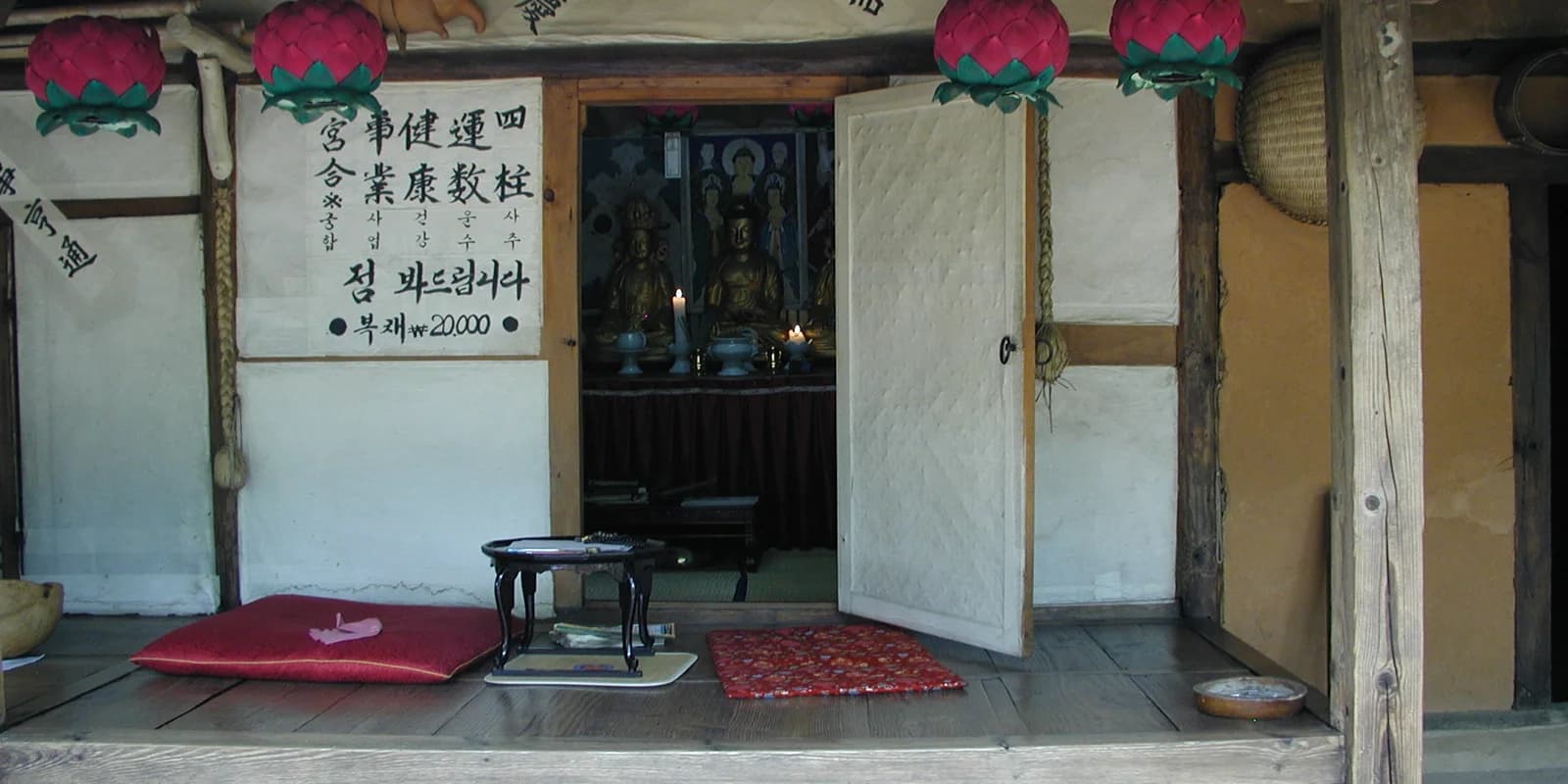
Ask a young Korean what they did on Saturday and there's a real chance the answer involves handing a stranger their exact birth date and time — over coffee, on a first date, or through an app — to have their fate read. Korean fortune-telling is in the middle of its biggest boom in decades: celebrity readers with waitlists stretching years, a Disney+ competition show that smashed premiere records, and AI services now helping parents time their babies' births. At the center of it all sits a word you'll hear constantly in Korea and almost never see explained properly in English: saju (사주). Here's the full picture — the system, the boom, the honest numbers, and the catch.
What Saju Actually Is
Saju's full name is 사주팔자 (saju palja) — "four pillars, eight characters." The four pillars are the year, month, day, and hour of your birth; each pillar is written as two classical characters (a "heavenly stem" and an "earthly branch"), giving eight characters in total, which a reader interprets through yin-yang and the five elements (Wikipedia). It's the Korean practice of what China calls BaZi, transmitted to Korea by the late Goryeo period and flourishing through Joseon (Encyclopedia of Korean Culture).
Two practical details define it. First, saju is calculation, not communion — a reader needs your precise birth data, not a crystal ball, and two readers given the same birth chart are working from the same eight characters. Second, it's cheap and social: a standard cafe reading runs about thirty minutes, priced around ₩50,000 at a typical Hongdae saju cafe, and the questions are relentlessly practical — career, romance, marriage timing, money (Korea Herald, 2025). If you know how much Korea already cares about birth years, the appeal of a whole cosmology built on birth data makes immediate sense.
Saju, Tarot, Shamans: Not the Same Thing
English coverage mashes these together; Korea keeps them firmly apart (Korea Herald, Korea Times):
- Saju — calendrical fate-reading by a 역술가 (yeoksulga), a scholar-practitioner of myeongni theory. Books, charts, calculation.
- 신점 (shinjeom) — spirit divination by a 무당 (mudang), a shaman who channels spirits; the mudang's grand ritual is the 굿 (gut). This is Korean shamanism proper — a different profession with a different source of authority.
- Tarot — the Western import, now standard equipment in Korean fortune cafes, typically for smaller, near-term questions.
A young Korean might casually use all three in one year. But when someone says they're "getting their saju read," they mean the birth-chart math, not the drums and spirits.
When Fortune-Telling Was a Government Job
The historical depth here is real. The Joseon court ran an office called 관상감 (Gwansanggam) — responsible for astronomy, the calendar, and geomancy — whose 명과학 (myeonggwahak) division existed specifically to divine auspicious dates and times for royal weddings, funerals, and state events (Encyclopedia of Korean Culture). Picking lucky days wasn't fringe; it was civil service, with exams.
The modern era added its own landmark: Seoul's Miari fortune-telling village in Seongbuk-gu, settled from the mid-1960s by blind diviners and reportedly home to around a hundred shops at its 1980s peak — with roughly thirty said to remain today, aging alongside their clientele (Wikipedia). Which makes what happened next all the stranger: the old trade didn't die with Miari. It moved to Gangnam cafes, apps, and streaming.
The Boom, by the Numbers
The clearest signal came this February. 운명전쟁49 — official English title "Battle of Fates" — a Disney+ survival competition pitting 49 fortune-tellers of every school (saju masters, mudang, tarot readers, face-readers) against each other, premiered February 11, 2026 and became Disney+ Korea's biggest-ever series premiere, beating Moving, adding hundreds of thousands of app users in weeks (Korea Herald, Variety). Its breakout cast now claim waitlists that read like satire — one mudang says she's booked until 2029 (Seoul Economic Daily, Her World; practitioner claims, worth the grain of salt). The show wasn't friction-free: one episode drew criticism for using a deceased firefighter's photo and birth details in a guessing mission — his family disputed having consented to that use, and Disney+ re-edited the episode (Kuki News).
The audience data backs the anecdotes. In an Embrain Trend Monitor survey of 1,200 Koreans reported this spring, 62.3% said they had used fortune-telling services, and the top reason wasn't belief — it was "relieving anxiety" (54.2%), ahead of "gaining direction" (33.8%). Interest in saju and tarot ran highest among teens and twenty-somethings, not their grandparents (Seoul Economic Daily).
The Apps and the AI
The delivery mechanism has fully modernized. 점신 (Jeomsin), the market-leading fortune app, has logged some 17 million cumulative downloads (EBN, 2026); rival 포스텔러 (Forceteller) counts millions of members of its own. And the frontier is already past apps: Korean media this month reported parents using AI saju services to time planned C-sections to "auspicious" dates and hours, and users cross-checking paid readings against ChatGPT (Korea Times, July 2026). A 700-year-old calculation system turns out to be an almost perfect fit for software: it was always an algorithm; it just used to run on paper.
How Big Is It, Honestly?
Here's where we depart from most coverage, because the famous numbers are shaky. You'll routinely see "Korea's fortune-telling industry is worth 4 trillion won — bigger than the film industry." That claim failed a YTN fact-check back in 2020 — no one could trace it to a real study (YTN). The best available estimate is more modest but still striking: data firm InnoForest puts the market around ₩1.4 trillion (roughly $1 billion) — likely an undercount, since much of the trade is paid in cash (Economist Korea, 2026). Claims about the number of practitioners (you'll see anything from 300,000 to 800,000) circulate without solid basis; treat them as folklore about the folklore.
The Catch
The boom has a shadow, and it's worth stating plainly. Fortune-telling in Korea is entirely unlicensed and unregulated — courts have generally treated readings as quasi-religious activity rather than consumer services (Korea Herald). And as the money grows, so does the harm at the edges: Korean reporting this month counted a 139% rise in complaints about SNS-based "shamanism" scams, with people in their 20s and 30s making up more than half the victims, and a decade's court rulings showing average damages in the hundreds of millions of won per case (Seoul Economic Daily, July 2026). Critics also worry about the entertainment wave itself — one commentator warns that packaging shamans as streaming stars "normalizes" the supernatural as a decision-making tool (Korea Times). Enjoy the reading; keep your bank account out of it.
Why Korea, and Why Now
Put the pieces together and the boom stops looking mystical. Korea is now majority non-religious — about 63% by 2023 — and scholars argue fortune-telling fills the vacuum organized religion left, offering meaning without membership (Korea Times). Young Koreans face brutal competition for jobs and housing — the same pressure cooker behind the Suneung machine — and the survey data says the quiet part: this is anxiety management, priced at ₩50,000 a session.
And it slots neatly into a national habit we've written about before: Korea loves a system that turns a person into a legible type. The country that made MBTI a second national ID — there is literally a show titled "MBTI vs. Saju" (Korea Times) — was never going to resist an older, deeper typology that runs on your birth certificate. MBTI asks what kind of person are you; saju claims to answer what kind of life did you get. In a country where both questions feel urgent, business is very good. And they aren't the only two in the field — blood type personality theory still commands majority belief, despite an origin story almost nobody who repeats it knows about.
Definitions and history are drawn from the Encyclopedia of Korean Culture and the linked references; survey figures, industry estimates, app statistics, and scam data are dated in-text and attributed to their sources — including the YTN fact-check debunking the widely-repeated "4 trillion won" figure, which we deliberately do not use. Waitlist claims are practitioners' own. The Battle of Fates episode controversy is reported per Korean press accounts, without speculation. Practitioner-count claims are described as unverified. Images are real, license-clean photographs of Korean fortune-telling, all via Wikimedia Commons (cropped): homepage/hero — zodiac fortune-capsule machines in Gyeongju by Basile Morin, CC BY-SA 4.0; cover — a jeomjip (fortune-teller's house) advertising saju readings at the Korean Folk Village, Yongin (a living-history museum setting), by Brendon Connelly, CC BY-SA 2.0; listing card — a 20th-century Korean divination manual at the National Folk Museum of Korea, by Ethan Doyle White, CC BY-SA 4.0.


Keep Reading
More Stories
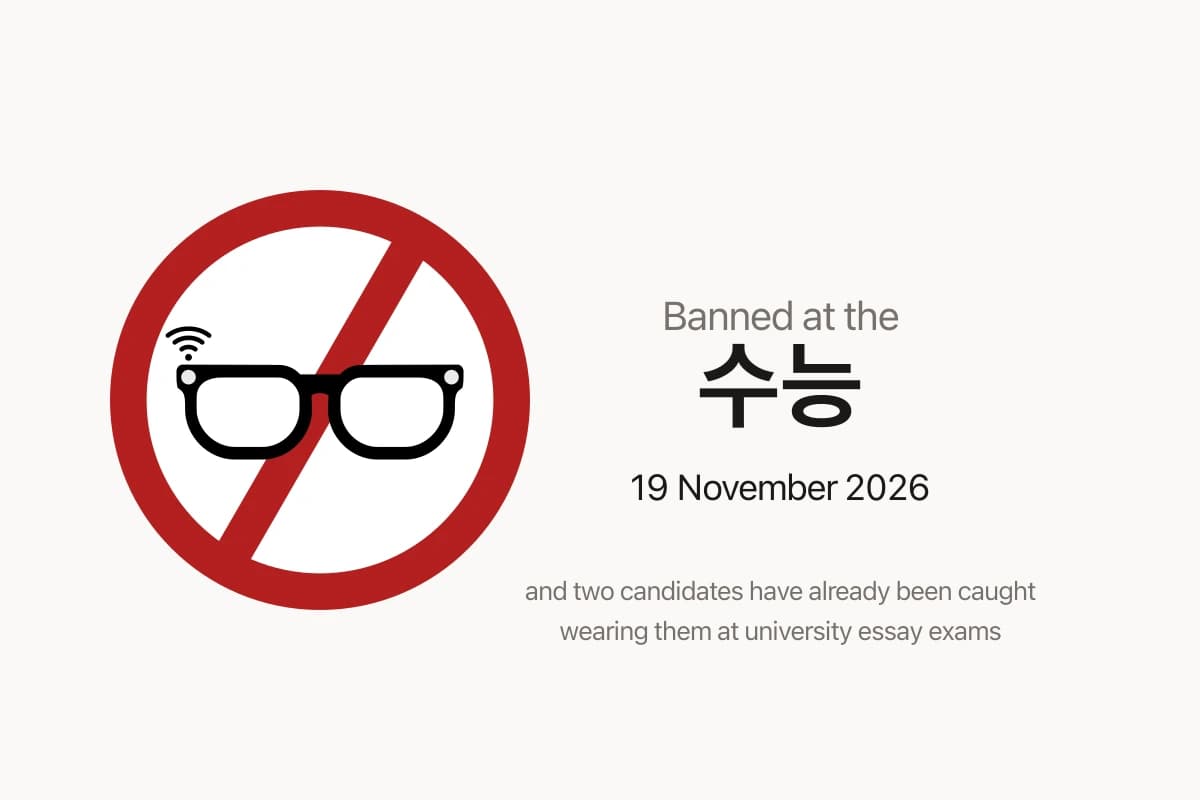
Two Candidates Wore AI Glasses Into Korean University Exams This Month. Five Weeks Later, 550,000 People Sit the 수능
At the University of Seoul on 3 October and at Yonsei a week later, proctors spotted AI smart glasses on candidates sitting essay exams for admission. Both had passed the glasses check in ordinary frames and switched once the exam began. The 수능 on 19 November already bans the devices; the question is whether anyone can see them.
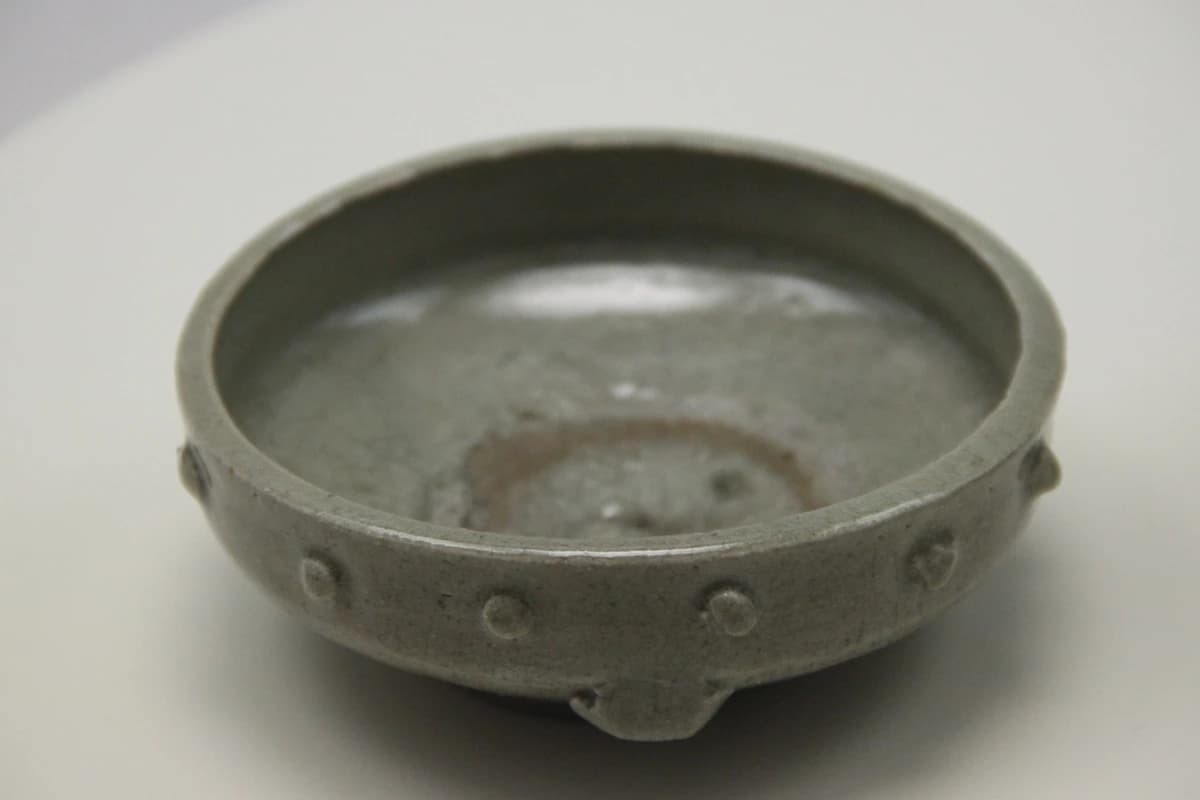
The Fisherman Hid It Under His Floorboards. The Reward He Eventually Got Set Off a Decade of Looting.
Korea marked fifty years of underwater archaeology in Mokpo in September 2026. The official story starts with a net and a report. The documented one starts with six pieces of Chinese porcelain given away as presents, a schoolteacher brother who had to get them all back, and officials who did not want the paperwork. Then the state paid a reward, a diver worked out how much of it went in tax, and for the next ten years people stole the wreck faster than the government could raise it — until the navy's own divers could not find the ship, and the excavation hired the looters.
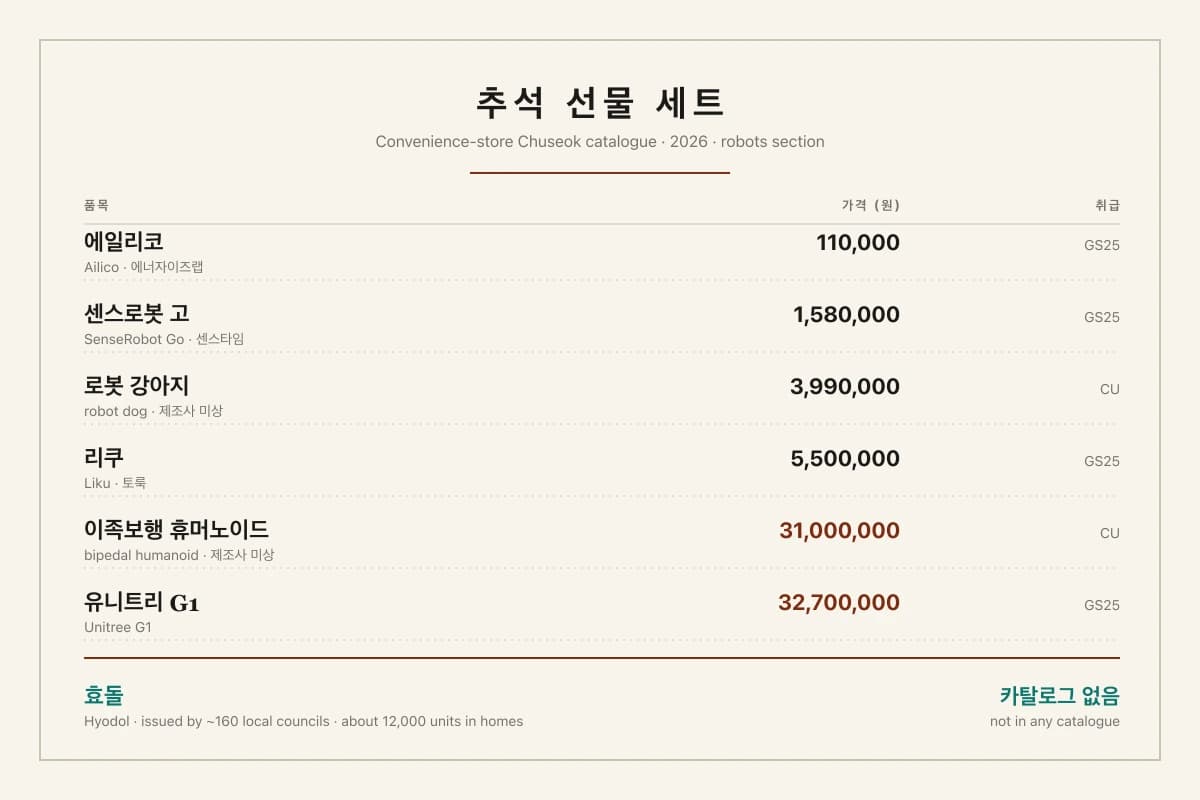
Korea's Convenience Stores Are Selling Humanoid Robots for Chuseok. Neither Chain Expects to Sell One, and Both Have Said So.
CU's holiday catalogue has a bipedal humanoid at ₩31 million, next to the beef and the gold bars. GS25 has an AI companion robot at ₩5.5 million and a keyring that talks back at ₩110,000. We assumed the pitch was companionship for parents you won't be visiting. It isn't — the retailers say plainly these are there to be noticed, not bought. Meanwhile about twelve thousand robots are already in Korean homes, asking elderly residents whether they've taken their medicine, and nobody put those in a catalogue.
The Weekly Dispatch
Korea, curated. Every week.
The best of K-culture, straight from Seoul. Written by people who actually live here.
Free, no spam, unsubscribe whenever.