T-Money Card, Honestly: How Korea's Transit Card Actually Works in 2026
Western travel sites still tell you to buy a Korea Tour Card and sign up for K-Pass. Both pieces of advice are wrong as of 2026. Here's the actual five-card landscape — T-Money, T-Money Travel Card, K-Pass, WOWPASS, and the new credit-card kiosks Seoul Metro rolled out in March — and what each one is really for.
There is a specific category of bad advice Western travel sites give foreigners about Korean transit. It goes something like: "Buy a T-Money card at the airport. Top it up with cash. Consider signing up for K-Pass to save money. The Korea Tour Card is a great tourist option."
Three of those four sentences are wrong or out of date as of May 2026.
This is the honest version: what actually exists in Korean transit right now, which card you actually want, and where the genuinely useful 2026 changes have happened that almost nobody has updated their guides to reflect.
One thing before we start. This article is the sequel to our Korean Travel Apps explainer — Naver Map and Kakao T both lean on the underlying T-Money system for fare calculation and routing. If you have not read that piece yet, the apps half of the toolkit lives there; this is the cards half.
The five-card landscape (yes, five)
| Card | Who it's for | Price | Top-up |
|---|---|---|---|
| T-Money (standard) | Anyone (residents, tourists, you) | ₩5,000 | KRW cash, KRW debit/credit, or NEW international cards at subway kiosks |
| T-Money Travel Card | Foreigners specifically | ₩4,000 | Same as standard T-Money |
| K-Pass | Korean residents only (ARC required) | Free (program) | Korean bank-linked card |
| WOWPASS | Tourists / short-term foreigners | ₩5,000 | 16 foreign currencies + KRW |
| Korea Tour Card | Discontinued / folded into the Travel Card | — | — |
Two of those five are confused with each other in much of the Western travel-site coverage. Two of them are products you almost certainly want. One is a product you cannot use. Below.
What T-Money actually is
T-Money (티머니) is the contactless transit card that runs the Seoul metropolitan transit system and, by extension, most of Korean public transit. The chip is a fairly standard NFC stored-value card — you tap, fare deducts, you go. The system extends to:
- Seoul Metro + the broader Seoul-Incheon-Gyeonggi subway network
- Seoul + Incheon + Gyeonggi city buses + intercity buses on most routes
- Many taxis (look for the T-Money sticker — most cabs in central Seoul take it)
- Convenience stores (CU, GS25, 7-Eleven, Emart24 — direct payment from the T-Money balance)
- Some cafés and chain restaurants — surprisingly, including most Lotteria, Paris Baguette, and Twosome Place locations
- KTX trains through a partner integration (the Korail-Tmoney bundle, but most people just use Korail Talk separately)
- Vending machines and lockers in subway stations
That last point is the one most foreigners do not realize. Your T-Money card is not "a transit card." It is a small, frictionless wallet you tap to pay for things, and the things include the lockers at Seoul Station, vending machines in subway concourses, and the iced americano at the Paris Baguette inside Incheon Airport.
Where to buy, what it costs
Every major convenience store sells the card. The four chains you will see in every Korean neighborhood — CU, GS25, 7-Eleven, Emart24 — all carry T-Money cards in standard ₩5,000 base packaging, often with limited-edition character designs that cost slightly more (range ₩3,000 to ₩6,000 depending on whether you want a BTS or a Pokémon).
The card price itself is non-refundable — what you pay for the card is for the card. The fare credit you load is separate and is refundable (or transferable) when you leave the country, minus a small processing fee.
At the airport: Incheon's convenience stores in the arrivals concourse sell T-Money cards. So do the staffed bus-ticket counters near the airport limousine bus stops. If you land at Gimpo, GS25 in the arrivals area is your move.
The "T-Money Travel Card" variant — ₩4,000, sold at the same outlets, designed for foreigners with a slightly different cap structure on top-up. Functionally identical to the standard T-Money for daily use. If a convenience store cashier hands you this instead of the standard one, accept it — it's the same product.
How to top up — and the March 2026 change that matters
This is where the most-recent meaningful change is, and almost no Western travel guide has it yet.
The classic three ways:
- Convenience store counter. Hand the cashier your card. Say "티머니 충전이요" (T-Money chungjeon-iyo) and how much cash you want loaded. Counter taps your card, takes your cash, hands back. Done.
- Subway station kiosks (Korean cash only, historically). Tall machines, "1회용 / 충전" interface, insert ₩1,000 / ₩5,000 / ₩10,000 / ₩50,000 won notes, follow the prompts, tap your card on the reader. Until March 2026, this was Korean cash only.
- Naver Pay / Kakao Pay if you have a Korean phone number tied to a Korean bank account.
What changed in March 2026:
Seoul Metro deployed new kiosks across major stations that accept international Visa, Mastercard, and UnionPay credit and debit cards for T-Money recharging. This rolled out on March 17, 2026 per Seoul Metro's announcement — and as of May, the upgraded kiosks are visible at most central Seoul stations including Seoul Station, Hongdae, Myeongdong, Gangnam, and the Lines 1, 2, and 9 hubs.
Before this change, the foreigner workflow was: bring Korean cash, find a working machine, top up. After this change, you can simply tap your Chase Sapphire or Wise card at the kiosk and recharge in seconds.
Caps: Minimum top-up ₩1,000, maximum ₩90,000 per transaction, maximum balance held on the card ₩500,000. Keep at least ₩5,000 loaded if you don't want to think about it during a day of riding around.
Subway fare math (Seoul, May 2026)
The base subway fare in Seoul as of 2026 is ₩1,550 for the first 10 km. Every additional 5 km adds ₩100. Most rides within Seoul proper land between ₩1,550 and ₩2,050.
The bigger number to know is the transfer discount. If you tap your T-Money on a bus and then on the subway (or bus → bus, or subway → bus) within 30 minutes, the second leg is heavily discounted — often free for the first transfer. The Seoul transit system treats your trip as one journey, not two separate fares, as long as you keep the chain alive.
This is the math Western travel guides leave out when they say "subway is ₩1,550." If you transfer cleanly, your ₩1,550 trip can include a bus, a subway ride, and another bus — all for that one base fare plus distance.
K-Pass — the trap most Western guides set
K-Pass (K-패스) is a Korean government cashback program for public transit. It launched in May 2024 and offers a monthly fare rebate ranging from 20% to 53% for users who take buses or subways at least 15 times in a month.
In 2026, the program got an expansion: a new ₩62,000/month subscription tier that grants effectively unlimited bus and subway rides until your accumulated fares hit ₩200,000, at which point you receive ₩138,000 cashback the following month. There is also a ₩100,000/month premium tier that adds GTX (the high-speed regional subway network in the Seoul capital area) and intercity buses. Discounted prices apply for teenagers, seniors, families with three or more children, and low-income households.
Here is the part travel sites omit: K-Pass enrollment requires a Korean bank account or Korean-issued credit/debit card linked to a Korean ID (resident registration number for citizens, ARC for foreigners). The cashback is paid back into that bank account.
If you are visiting Korea on a tourist visa, you almost certainly cannot enroll in K-Pass. It is a domestic-resident discount program, full stop. Foreigners with Alien Registration Cards (Residence Cards) can enroll. Tourists cannot. Western travel sites that recommend "sign up for K-Pass before you travel" are recommending something you cannot actually do.
This matters because the K-Pass rebate is genuinely substantial — for a 30-day Seoul trip with daily transit use, the math could save you ₩60,000 to ₩100,000. If you are eligible (i.e., you have an ARC), it is one of the most valuable transit moves you can make in Korea. If you are not eligible, you need the next card on the list instead.
WOWPASS — the actual foreigner solution
WOWPASS is a foreigner-targeted prepaid card that does three things on one piece of plastic:
- Currency exchange at decent (not best, decent) rates — load USD, EUR, JPY, and 13 other currencies, get a Korean won balance to spend with
- Prepaid debit-card payments anywhere that takes Korean cards
- Built-in T-Money chip for transit and contactless retail payments
The card costs ₩5,000 and can be picked up at WOWPASS kiosks scattered across Seoul (Incheon Airport arrivals, every Hongdae and Myeongdong tourist hub, Lotte and Shinsegae department stores). You exchange foreign currency at the kiosk; the won balance lands on the card; you can spend it anywhere a Korean card is accepted.
The exchange rate at WOWPASS is better than airport currency counters and roughly equivalent to major bank rates in Myeongdong — not the absolute best on the market (Myeongdong and Namdaemun money changers still win on raw rate), but good enough that the convenience of having a working card immediately on arrival usually wins.
Limits to know: Daily top-up cap of ₩2,000,000; weekly cap of ₩10,000,000. Those are absurd for normal travel use; they exist for regulatory reasons.
Critical detail Western guides get wrong: The T-Money portion of WOWPASS is a separate balance from the WOWPASS prepaid balance. You cannot recharge the T-Money side with foreign currency — only with KRW cash at subway kiosks or convenience stores (or, as of March 2026, with an international credit card at the new kiosks). So a WOWPASS user typically: loads currency once for the prepaid debit balance, then tops up T-Money separately as needed.
If you are a tourist or short-term visitor, WOWPASS is the closest thing Korea has to a "card you can just use" without a Korean bank account.
The honest pick — tourists vs residents
For tourists (under 90 days, no ARC):
- Default to WOWPASS if you want one card to do most things — fare, restaurant payments, convenience store, retail
- Add a regular T-Money if you want the slightly cheaper card price and don't need currency exchange
- Skip K-Pass — you cannot enroll without a Korean bank account / ARC
- Skip the "Korea Tour Card" — it has been folded into the T-Money Travel Card; the brand name still floats around old travel guides
For long-term residents (ARC holders):
- T-Money for daily tap-and-go
- K-Pass if you ride transit 15+ times per month (you almost certainly do, in Seoul) — the cashback math is meaningful
- Skip WOWPASS — you have access to a Korean bank account; WOWPASS is solving a problem you don't have
For everyone:
- After March 17, 2026, you do not need Korean cash to recharge T-Money. The new Seoul Metro kiosks accept international cards. This is the single biggest QoL improvement Korean transit has shipped for foreigners in years.
What to actually do at the airport
A practical sequence if you are arriving at Incheon and want to be transit-functional within 20 minutes of clearing customs:
- Exit customs at Incheon Arrivals.
- Walk to a WOWPASS kiosk (signage is everywhere, can't miss them — also located right inside the arrivals concourse). Buy a WOWPASS card and load your home currency. 5 minutes.
- Skip the airport currency counter — WOWPASS rates beat them.
- If you also want a separate T-Money — go to any convenience store in the arrivals area, buy one for ₩4,000 (the character editions are ₩5,000), top up ₩30,000 in cash or via card at the new kiosks. 5 minutes.
- Take the AREX express train into Seoul. Tap your T-Money or WOWPASS at the gate. ~50 minutes to Seoul Station, ~₩9,500 for the express, or ~₩4,750 for the all-stop train.
That's the entire pipeline. Almost every other piece of advice you'll see online is either obsolete, misnames a discontinued product, or recommends something you can't actually enroll in.
The editor's note
If you take one thing from this article: K-Pass is for residents, not tourists. The Western travel sites that confuse those two cost their readers hours of frustration at apps that don't accept foreign phone numbers or Korean bank account verifications.
The other thing worth knowing: as of March 17, 2026, the foreigner experience of Korean transit got materially better. You no longer need Korean cash to keep your T-Money topped up. That single kiosk change quietly closed the largest UX gap between local and visitor that has existed in Seoul transit for the last decade.
The cards are not the story. The cards have always worked. The story is which one you pick and what you stop carrying. After 2026, the answer for most foreigners is one card — either WOWPASS or T-Money — and a tap. And the other money question every first-timer asks — do you tip in Korea? — has an even shorter answer: no.
—The Editors
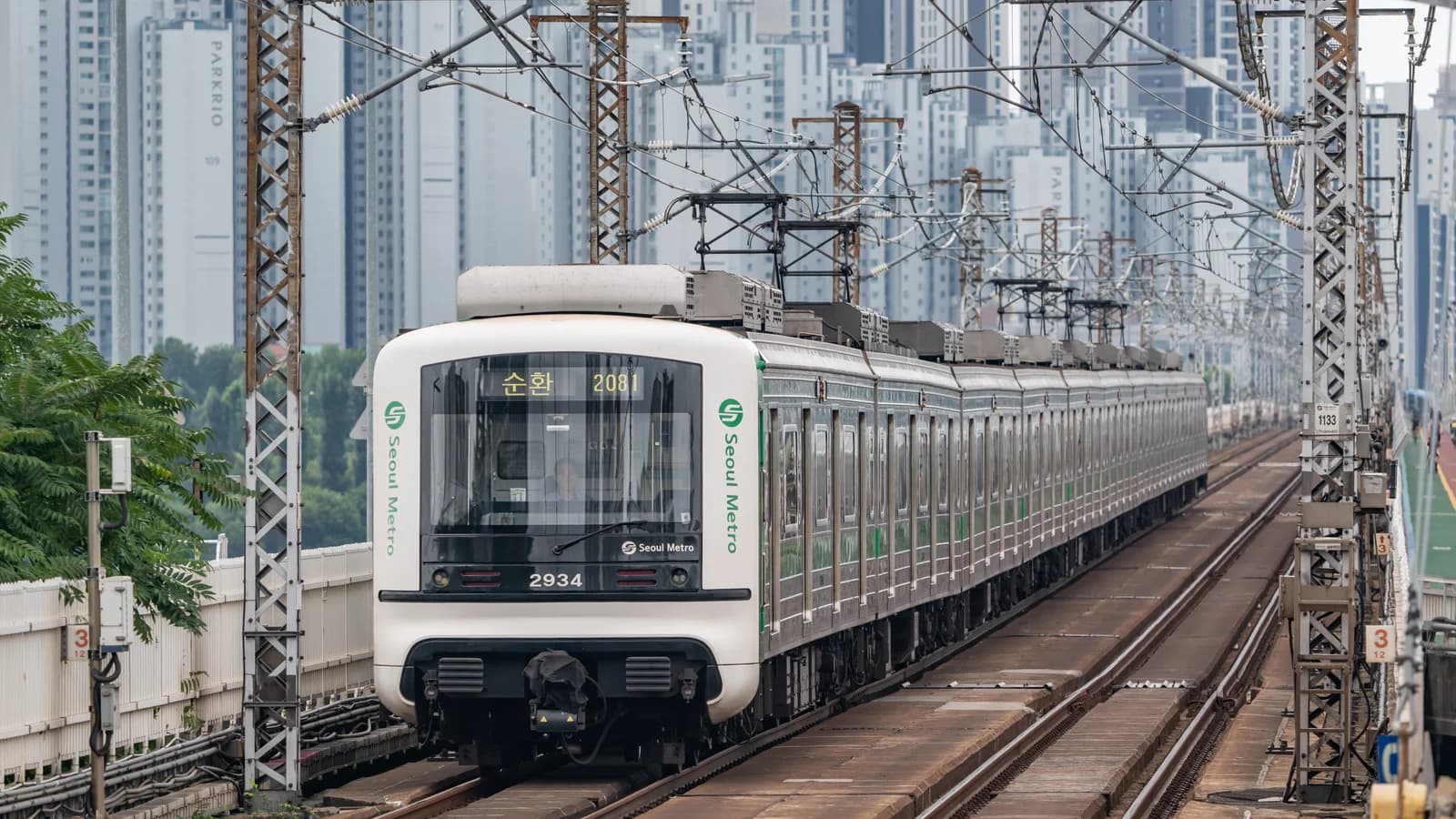
Cover: Seoul Metro Line 2 train at Gangbyeon, August 2025, by Yuqiao. Card: Seoul Metro Line 2 train arriving at Guro Digital Complex, by Mtattrain. Both licensed under CC BY-SA 4.0 via Wikimedia Commons. Cropped from originals.
Sources: Korea Times, Korea.net, Visit Korea, WOWPASS official, K-Pass via Namu Wiki. Fare figures verified against Seoul Metropolitan Government transit notices as of May 2026.
Keep Reading
More Stories
황사 Is Not 미세먼지: What Korea's Air Quality Alerts Actually Mean
English coverage treats yellow dust and fine dust as the same problem. Korea's own forecasters subtract one from the other before publishing. A guide to the two seasons, the alert thresholds, what KF94 actually certifies, and why 'it all comes from China' is a number swap.
The Mud Korea Decided to Save: Getbol and the UNESCO Vote in Busan
The least Instagrammable thing Korea could nominate — a coastline of mud — is a UNESCO World Heritage site, and on July 25, 2026, in the one year Korea controlled the room, it was made bigger. A guide to getbol: the flats that feed millions of migrating birds, the women who ride wooden sleds across them, and why a country that once paved its tidal flats now enshrines them.
Jjimjilbang for First-Timers: How Korea's Bathhouses Actually Work
Yes, the bath part is fully nude. No, nobody cares. A step-by-step guide to the Korean spa-sauna-sleepover — the sheep-head towel, the scrub that removes a layer of you, which famous venues have quietly closed — and why the neighborhood bathhouse is disappearing even as the tourist jjimjilbang thrives.
The Weekly Dispatch
Korea, curated. Every week.
The best of K-culture, straight from Seoul. Written by people who actually live here.
Free, no spam, unsubscribe whenever.