POSCO: How Korea Forged Itself in Steel
Every other giant in Korea's rise was a family dynasty. POSCO wasn't. It was a government-willed steel mill, built on an empty Pohang beach with settlement money from Japan, by a general who told his workers that if they failed they should all walk into the sea. This is the story of the chaebol that isn't a chaebol — and its late-life gamble to forge Korea's battery age.
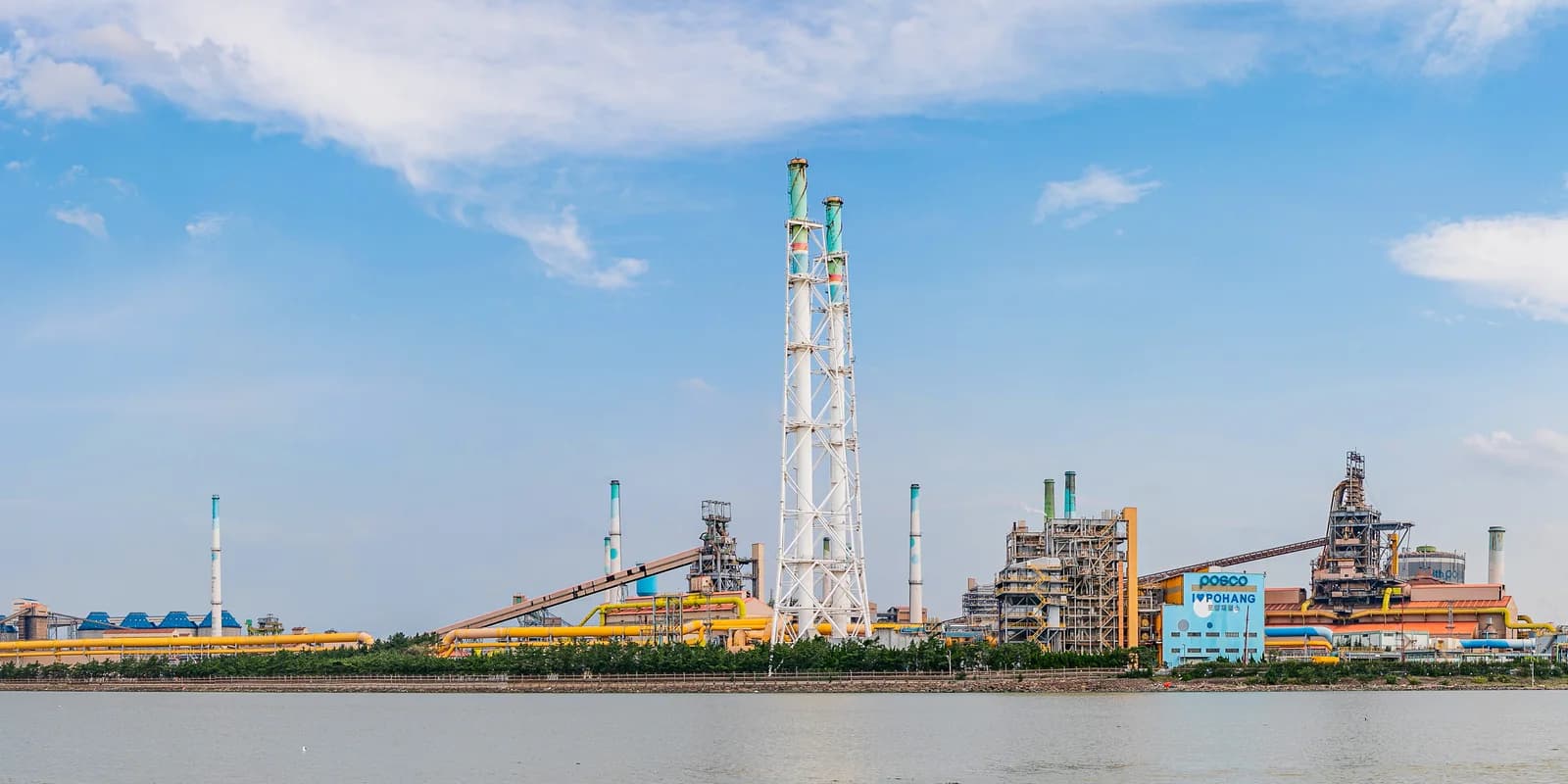
There is a vow at the heart of the POSCO story, and it is not a metaphor. In the early 1970s, as workers raised a steel mill out of the sand on an empty beach in Pohang, their leader — a retired army general named Park Tae-joon — told them what would happen if they failed. The money building the mill had come from a bitter settlement with Japan, the country that had colonized Korea. To waste it would be a national disgrace beyond bearing. So if the steelworks failed, Park said, they would all turn right and march into the waters of Yeongil Bay together. POSCO enshrines the line to this day as its "Right-turn Spirit" (우향우 정신) — a promise of no retreat, drowning over dishonor.
They did not fail. The mill on the beach became one of the largest and most respected steelmakers on earth, and the steel it poured became the skeleton of modern Korea — the cars, the ships, the skyscrapers, the appliances. But POSCO is the odd one out in our series on how Korea got rich. The Lees of Samsung, the Chungs of Hyundai, the Cheys of SK, the Koos of LG — every other great Korean fortune is a family dynasty. POSCO has no family at all. This is the story of the chaebol that isn't a chaebol.
A Country With No Iron, No Coal, No Capital
To feel how improbable POSCO was, start with what 1960s Korea did not have. It had almost no capital. It had no meaningful iron ore or coking coal of its own. It had no steelmaking technology and no one who knew how to build an integrated mill. It was a poor, largely agrarian country a decade removed from a devastating war. On paper, a nation like that has no business building world-scale heavy industry.
The Park Chung-hee government decided it had no business not to. Steel is the input to everything else a modern economy makes — you cannot build cars, ships, or buildings without it — so an integrated steel mill was treated as the indispensable first brick of industrialization. In April 1968, the state founded Pohang Iron and Steel Company (포항종합제철) — POSCO — as a government-owned enterprise, and handed it to Park Tae-joon, a trusted confidant who had served alongside Park Chung-hee as an army officer and joined his 1961 coup (POSCO, Wikipedia). The state would own more than 70% of it until 1988 (POSCO 20-F/Wikipedia). This was not an entrepreneur's gamble. It was a country building itself an organ it could not live without.
The Money From Japan
Where does a broke country find the money for a steel mill? In POSCO's case, from the most politically loaded source imaginable. When Korea and Japan normalized relations in 1965, the treaty came with an economic settlement — commonly cited as around $500 million, split between grants and low-interest loans (Wikipedia, The Korea Times). Korea funneled a large share of that settlement into industrial projects, and the single biggest corporate slice — on the order of $120 million — went into the Pohang steel mill, along with technical help from Japan's own steelmakers like Nippon Steel (Nikkei Asia, Wikipedia).
Precision matters here, because the popular retelling flattens it. It is often said that "Japanese reparations built POSCO." That is too neat. The $500 million was the whole settlement — spread across roads, dams, and infrastructure — and only about a quarter of it built the mill. And "reparations" is a word Japan pointedly never used: the funds were formally styled "economic cooperation" and "property-claims settlement," not compensation for colonial rule — a distinction that still stings in Korea. But strip the arithmetic down and the emotional core is real and extraordinary: money wrung from the former colonizer was poured into the furnace that would power Korea's independence from it. That is why Park Tae-joon invoked the sea. The steel was national honor, cast in molten form.
The Mill on the Beach
Construction of Pohang Works began in 1970, on reclaimed land by the coast. Three years later, on June 9, 1973, Blast Furnace No. 1 tapped its first molten iron — reportedly a month ahead of schedule — and the plant was dedicated that July as Korea's first integrated steel mill, with a starting capacity of about 1.03 million tonnes a year (POSCO, Wikipedia). A country that a generation earlier had been among the poorest on earth was now making its own steel, from ore to finished product, on its own soil.
From Pohang, POSCO scaled. Between 1982 and 1992 it built a second, even larger integrated works at Gwangyang on the southern coast — a complex that would grow into one of the biggest single steelworks in the world, with crude-steel capacity around 23 million tonnes a year at its peak (Global Energy Monitor). Together, Pohang and Gwangyang made POSCO a heavyweight of global steel: the world's 7th-largest steelmaker in 2015 at roughly 42 million tonnes, and still the 8th-largest in 2024 at 37.79 million tonnes, per the World Steel Association (worldsteel via Wikipedia) — a mid-table finish only because the top of the table is now dominated by enormous Chinese state producers led by Baowu. For decades POSCO has been spoken of as one of the most efficient steelmakers anywhere; that's an industry reputation more than a single statistic, but it is the reputation the mill on the beach earned.
The Steelmaker That Built a University
Here is the detail that tells you what kind of institution POSCO was trying to be. In 1986, the steelmaker founded a university — the Pohang University of Science and Technology (POSTECH / 포항공과대학교), championed personally by Park Tae-joon and modeled explicitly on Caltech, Korea's first research-focused science-and-technology university (POSTECH). The logic was pure Park Tae-joon: "You can import coal and machines," he is quoted as saying, "but you cannot import talent." A company that made girders and rebar spent its money building brains, because it understood that steel was only the first chapter of a country's climb, not the last.
The Chaebol That Isn't a Chaebol
Now the twist that sets POSCO apart from every other house in this series. Through the 1990s the government sold down its stake, and by 2000 POSCO was fully privatized; in 2002 it dropped "Pohang Iron & Steel" for the sleek modern name POSCO (POSCO, Wikipedia). But it did not privatize into a family. There is no founding bloodline controlling POSCO, no third-generation heir, no succession drama. It is widely held and professionally managed — its largest shareholders are institutions like Korea's National Pension Service and BlackRock, each holding only a single-digit percentage, with no controlling block at all (Wikipedia).
That makes POSCO the great exception to the story we've been telling. Samsung, Hyundai, SK, and LG are dynasties — family empires steered across generations from slim ownership stakes, forged in feuds and pardons and inheritance suits. POSCO was a government project that grew up and left home, run not by a clan but by managers who rotate through the corner office. In a country defined by its wealth clans, the company that literally forged the nation's industrial spine belongs to no one in particular — which may be exactly why it stayed out of the dynastic melodrama that shadows all the others.
Forging the Next Age
A 55-year-old steelmaker faces an awkward question: what do you do when the industrial age you were built for starts to age out? POSCO's answer is a second, riskier bet — that the company that supplied Korea's cars and ships can supply the insides of the world's electric vehicles.
In 2022, POSCO restructured into a holding company, POSCO Holdings, sitting atop the steel business and freeing the group to chase new growth engines — above all, battery materials (KED Global). It announced a roughly $20 billion push through 2030 into rechargeable-battery materials, aiming to become a vertically integrated supplier of the lithium, cathodes, and anodes that go inside EV batteries, and to challenge the Chinese firms that dominate that supply chain (KED Global). Its materials arm, POSCO Future M (renamed from POSCO Chemical in 2023), makes cathode and anode materials; the group has built lithium projects stretching from a brine operation in Argentina to a Korean plant that processes Australian ore (POSCO Future M). The steelmaker is trying to reinvent itself the way SK once reinvented itself from oil into memory chips — betting the house on the next material the world can't do without.
It is not a sure thing. A 2024–2025 slump in steel demand and battery-metal prices has squeezed POSCO hard, forcing restructuring and asset sales; its 2024 revenue of about ₩72.7 trillion came with sharply lower profits (POSCO Holdings 2024 results). The pivot is real but unproven, and the open question hanging over POSCO is the one under all reinventions: can the company that forged Korea's industrial past forge its electric future — or is it a steel giant chasing a boom that may not wait for it?
The Honest Ledger
A company that made itself a symbol of national pride carries national-sized burdens too. POSCO's coal-fired mills are, by some measures, Korea's single largest industrial source of air pollution, with the Gwangyang and Pohang works linked to significant fine-particulate and NO₂ emissions and billions of won in estimated health costs (CREA/SFOC study). It has been accused of "greenwashing" — marketing steel from coal blast furnaces as eco-friendly while spending heavily to extend those furnaces' lives — a contested allegation now tangled in the courts. And its plants have logged a recurring pattern of serious industrial accidents. The steel that built the country is also, unavoidably, part of the emissions problem the country now has to solve.
That is the fitting complication for POSCO's story, because it was never a fairy tale. It was a poor country's audacious wager — settlement money from an old enemy, a general threatening the sea, a mill on an empty beach — that Korea could forge its own future out of iron. The wager paid off spectacularly. The furnace that Park Tae-joon's workers vowed to die beside is still burning, still trying, at 55, to figure out what to forge next. No family owns it. In a sense, the country does.
Cover: the POSCO Pohang Works on the waterfront — photo by Aatu Dorochenko, Wikimedia Commons, CC BY-SA 4.0. Homepage/hero (a steel-mill interior) and listing card (rolled-steel coils) are illustrative heavy-industry photographs via Pexels (Pexels License), not POSCO facilities. Financial, production, and market-share figures are dated in-text and drawn from the linked sources; they are snapshots that move constantly. The "Right-turn Spirit" vow is POSCO's own documented founding legend, presented as such. The 1965-settlement financing is described precisely — funds from the settlement, not "reparations," a term Japan did not use — and the environmental and "greenwashing" matters are framed as record and contested allegation respectively.

Keep Reading
More Stories
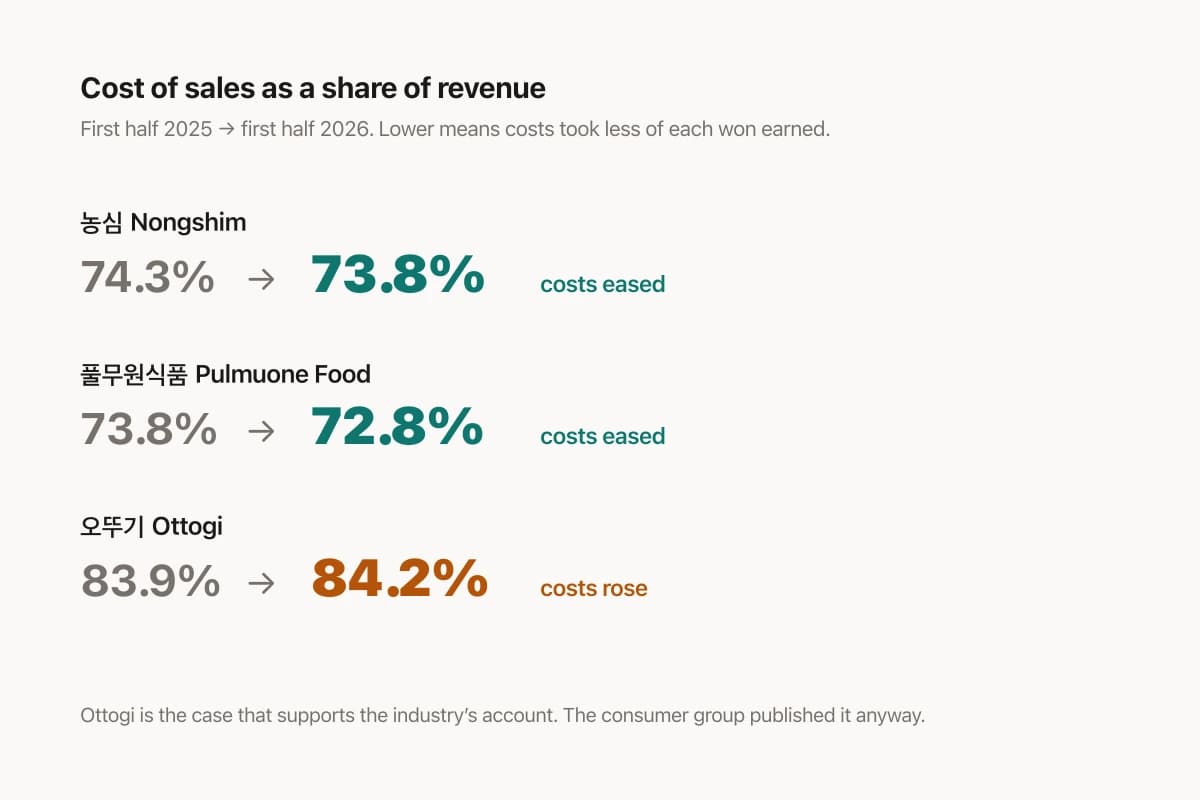
In April, Nongshim Cut Prices to Help With Inflation. In August It Raised Them, Using the Same Sentence.
Korea's biggest noodle company cut sixteen products in the spring, framed as joining the government's price-stability drive. Four months later it raised forty-three, framed as joining the government's price-stability drive. The products it cut are precisely the ones it left alone in August — and its own filings show the cost pressure it blames has not yet reached its margins. The awkward part is that the cost pressure is real.
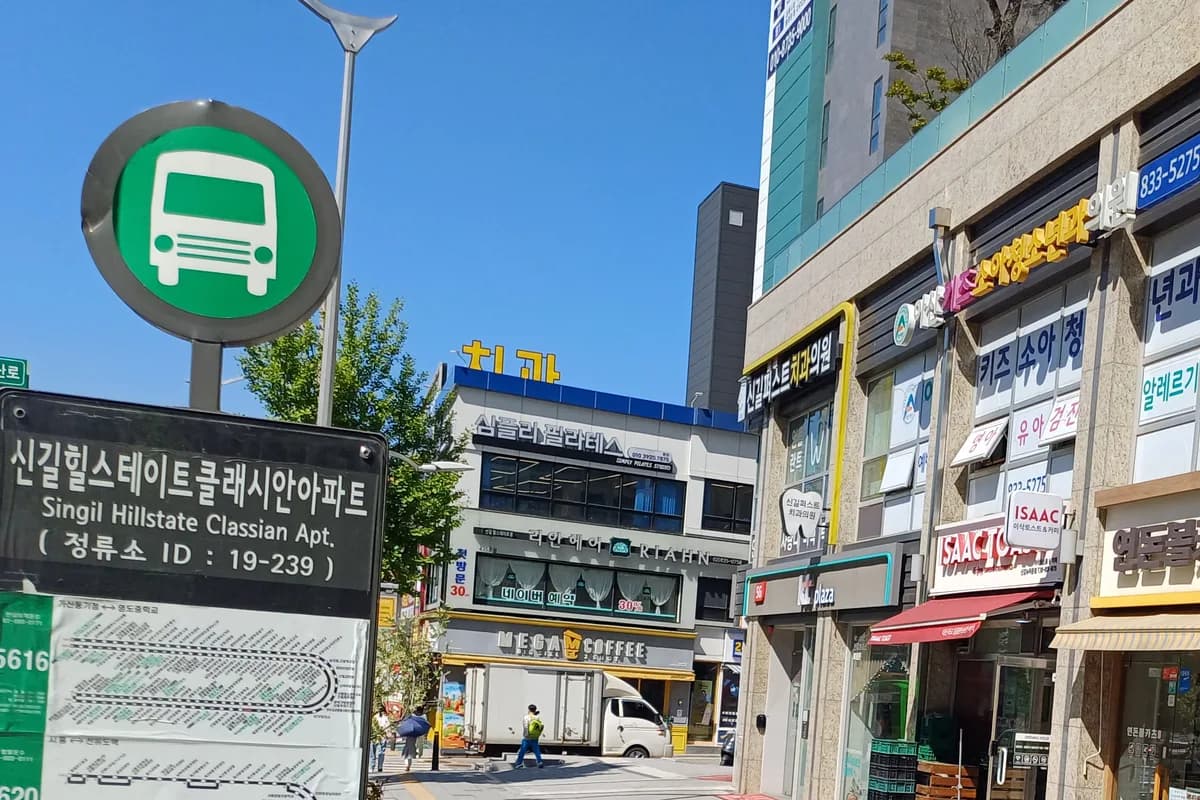
Korea's Longest Apartment Name Is 25 Characters — Seven Longer Than the Joke
Everyone says the names got long so mothers-in-law couldn't find the address. Twenty years of Korean and English coverage repeat that, and not once does anyone say it in the first person. Here is what actually happened: a decoder ring for 센트럴 and 포레, a Swedish word from a company with no Swedish business, and a 2021 study showing the thing residents vote hardest for doesn't work.
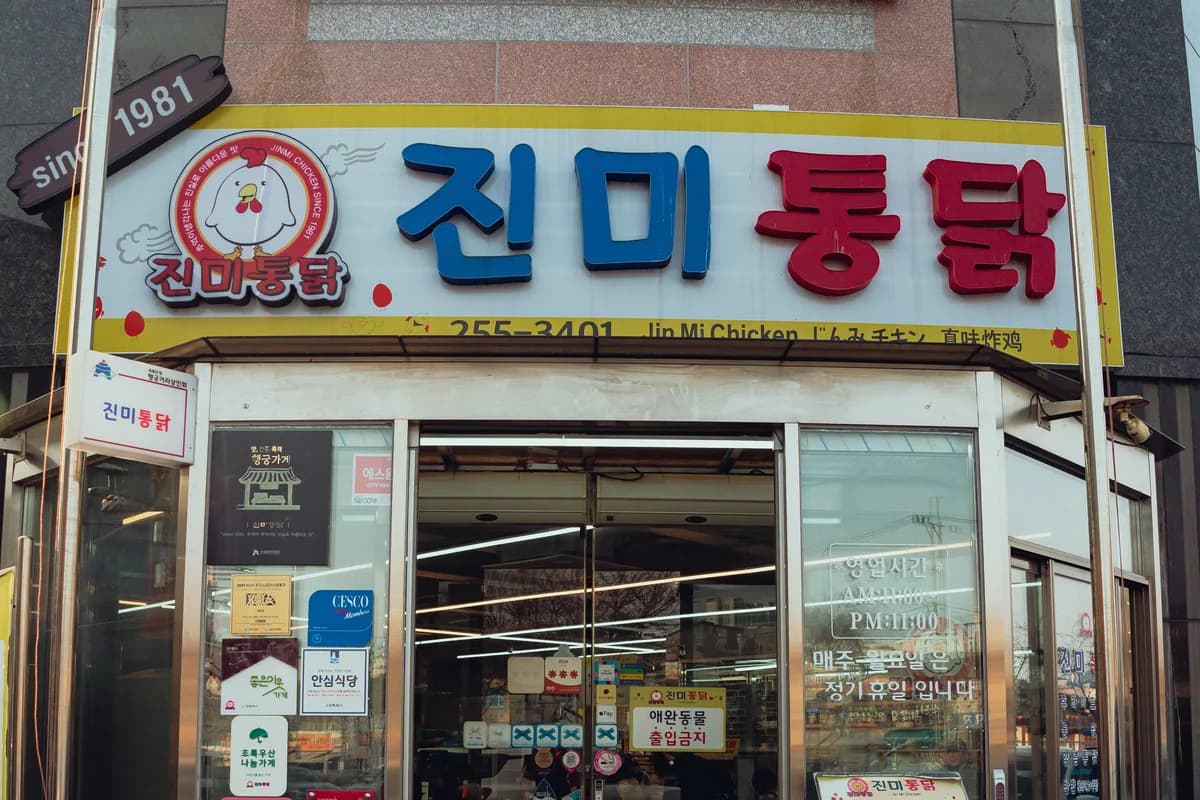
Korea Has Fewer Chicken Shops Than McDonald's Has Restaurants — the Famous Claim Was Counting Beer Halls
The number everyone quotes comes from a 2019 bank report whose own footnote says it includes 호프/통닭 licences and differs from the official count. On the like-for-like series the comparison is now the wrong way round. Four government bodies count Korean chicken shops four ways, two of them moving in opposite directions in the same year — and a decree amended last week finally requires the shops that closed to appear in the revenue forecast you're handed before you sign.
The Weekly Dispatch
Korea, curated. Every week.
The best of K-culture, straight from Seoul. Written by people who actually live here.
Free, no spam, unsubscribe whenever.