Aegyo Doesn't Mean Cute: 애교, and Why Korea Argues About How It's Done
Korea's national dictionary defines 애교 not as cuteness but as the attitude of appearing cute to others — and defines 'cute' partly in terms of it. A guide to the pitch contour, the nasal consonants and the baby-talk that make it work, and to why a variety show can ask an idol to perform it and then rule that she failed.
In February 2009, on a Korean variety show, five members of Girls' Generation were asked one by one to perform 애교 for a panel of male judges. When it reached Sooyoung, she said she couldn't. "I really can't do aegyo. I don't have aegyo." She attempted it anyway. The host's verdict, delivered to camera: this is her real self — it cannot be done even if you try.
Hold onto that, because it contains everything the English-language explanations leave out. Aegyo is not a mood, a personality trait, or a synonym for cuteness. It is a performance with a technique, one that can be demanded of you in public, graded by strangers, and failed.
Which is why the argument Koreans actually have about aegyo is not whether it should exist. It's about whether it was done properly.
What the Dictionary Actually Says
Start with Korea's national dictionary, because the correction is right there in the entry.
표준국어대사전 defines 애교 (愛嬌) as: 남에게 귀엽게 보이는 태도 — an attitude of appearing cute to others.
Read that wording carefully. Not "being cute." Appearing cute, to others. The other-directed, produced quality is written into the official definition.
Now look up the word that actually means cute. 귀엽다 is defined as 예쁘고 곱거나 또는 애교가 있어서 사랑스럽다 — lovable because one is pretty and fine, or because one has aegyo.
So in Korean lexicography the relationship runs one way: aegyo is one of the things that makes a person 귀엽다. It is a cause of cuteness, not a synonym for it. 귀엽다 is a verdict the observer reaches; 애교 is conduct the performer produces.
Every English gloss that renders aegyo as "cuteness" or "acting cute" has the relationship backwards. And the everyday verbs confirm it: Koreans say 애교를 부리다 or 애교를 떨다 — to put on, to lay on aegyo. It's something you do.
The most useful proof that this is about eliciting doting rather than about being adorable: Korean applies 애교 freely to animals. A dog has aegyo. A cat has aegyo. A parrot can have aegyo toward its keeper. No English sentence about "cuteness" quite covers what that means.
The Technique
Aegyo has identifiable mechanics, and linguists have measured them.
A 2025 study in Language and Speech compared aegyo speech against ordinary speech in Seoul Korean and found it uses longer vowels, a slower speech rate, higher average and maximum pitch, and markedly more variability in both pitch and vowel length. It's a coordinated set of adjustments, not a vague softening.
The linguistic anthropologist Kyuwon Moon, whose work at Stanford is the richest account of how aegyo is actually built, identifies four core resources:
The contour. A rising-then-falling tone on the final syllable of a phrase, which stretches to carry it. In its subtle form it's a gentle softener; widen the pitch swing and lengthen it and you get childish aegyo. It mirrors the body-wiggle that goes with it — and in casual writing and on-screen subtitles it's rendered as a tilde. That ~ in Korean text is a transcription of a real intonational move.
오빠. The single most aegyo-laden word in the language, because aegyo trades in a gendered and romantic frame. Moon notes that 누나 doesn't carry the same charge — it places the man below the woman in age, and the fantasy doesn't work in that direction. If you've met the four sibling titles, 오빠 is the one aegyo reaches for.
콧소리 — nasality. The feature Koreans most associate with aegyo; when Moon asked people to define the word, several used 콧소리 inside the definition. It comes in two forms: a nasal voice quality across a whole phrase, and — more precisely — adding a final ㅇ [ŋ] to open syllables. 잘 자 becomes 잘 장. 밥 먹어요 becomes 밥 먹어용. In writing it arrives with tildes and emoticons.
혀 짧은 소리 — "short-tongue sound." Infantile consonants, produced by turning fricatives and affricates into stops. 했어 becomes 했쪄; 하지마 becomes 하디마; the two can compound into 했떠. This is the most stigmatised marker by some distance — Korean newspapers have framed it as a speech defect to be corrected, and an actress who used it in a single line of a 2003 drama was mocked for it for years.
To which the physical repertoire adds: bouncing on the spot, body-twisting, cheek-puffing, wide eyes with a head-tilt, clinging, referring to yourself in the third person instead of saying "I," and 뿌잉뿌잉 — loose fists wiggled beside the cheeks with the accompanying vocalisation. That one has a traceable history: claimed by several online broadcasters from the mid-2000s, it broke into the mainstream through a 2011 sitcom, and if you know TWICE's "CHEER UP," Sana's 샤샤샤 is a 뿌잉뿌잉.
Note something structural here. All of these live in pitch, nasality, vowel length and consonants — not in verb endings. Which means aegyo runs on a completely separate machine from the honorific system, and the two operate simultaneously. You can be in flawless 존댓말 and doing full-blown aegyo at the same time.
It Has a Curriculum
The strongest evidence that aegyo is a skill rather than a disposition is that Korea teaches it, grades it, and has written it down.
On the variety show 주간 아이돌 (Weekly Idol), guests are routinely made to perform an 애교송 — an aegyo song. These are not improvised. The show's official aegyo songs — 내꼬해송, 얌얌송, 매미송, 오또케송, 렌즈송 — were written and composed by 효정 of OH MY GIRL, lyrics and music both.
There is, in other words, an authored songbook of standardised aegyo performances, and idols are expected to know the repertoire.
That is a genuinely odd thing for a culture to produce if aegyo were simply "being cute." You cannot compose a songbook for a personality trait.
And because it is a skill, it has a failure mode — a specific one. Moon's central observation is that aegyo has to look genuine while everyone in the room knows it isn't. She compares it to cosmetic surgery: people accept the artifice as long as it reads as real. An obviously fake aegyo is a failed aegyo, and is judged harshly. Which is exactly what happened to Sooyoung on television in 2009.
Not Kawaii, and Not Uniquely Korean Either
Two opposite errors circulate in English, and they're both worth dismantling.
Error one: aegyo is just Korean kawaii. The Oxford English Dictionary, which added aegyo in September 2021 with first evidence from 1997, cross-references kawaii in the entry. It shouldn't.
Kawaii is an adjective — an aesthetic judgement you apply to things. A pencil case is kawaii. A font is kawaii. Hello Kitty is kawaii. 애교 is a noun for behaviour a living thing performs. You lay it on, you can be asked to do it on camera, you can be bad at it, you can refuse. A pencil case cannot have 애교. A dog can.
Error two: aegyo is untranslatable and uniquely Korean. The two characters 愛嬌 — 愛 "love" plus 嬌 "comely, alluring," a character written with the 女 radical — are shared with Japanese, where the word is 愛嬌 (aikyō) and the spelling is documented as an early-modern respelling of an older word, 愛敬. Chinese has 撒娇 (sājiāo), sharing the same 娇/嬌 character, for a comparable feminine-coded coaxing style.
But the grammar of use differs, and that's the real finding. Japanese dictionaries note that 愛嬌 is something a person innately has — 愛嬌のある娘, a girl who has charm — explicitly contrasted with 愛想, the attitude one deliberately puts on to please. Korean does the opposite: 애교 is what you 부리다, what you lay on. Japanese lexicalises a possessed quality; Korean lexicalises a performed act.
There's a sharper asymmetry with Japanese still. The Japanese word for a woman performing exaggerated childish cuteness is ぶりっ子 (burikko) — and it is a pejorative label. 애교 is not. Same broad behaviour, opposite valence in the dictionary. That difference is the reason Korean can hold a public argument about aegyo's execution rather than simply condemning it.
Korean also has its own gradient for this territory, and it's precise:
| Word | What it is |
|---|---|
| 귀엽다 | cute — the observer's verdict |
| 애교 (愛嬌) | charming conduct; broadly positive |
| 아양 | fawning to be doted on — carries calculation |
| 교태 (嬌態) | a comely bearing, with an element of sexual enticement |
Note the middle one. 아양 is a native Korean word defined as 알랑거리는 speech or acts — toadying, flattering — done to be doted on. Korean already has a word for aegyo-done-cynically, and it isn't 애교. When English writing treats aegyo as inherently manipulative, it's describing 아양.
The One About the Eye
A quick, satisfying correction, because English sources including Korean English-language newspapers get it wrong.
애굣살 (formerly written 애교살) is the small ridge under the eye that Koreans consider attractive — the reason for a cosmetic procedure exported under the English name "baby eye fat."
It is not fat. NIKL's open dictionary defines 애굣살 as the flesh that rises cutely under the eye when you smile — it is the orbicularis oculi muscle contracting with expression. Korean sources are emphatic that 애굣살 and 눈밑지방, under-eye fat, are 전혀 다르다, completely different: the fat pad sits below it, and is a marker of ageing that people pay to have surgically removed.
So the desirable feature and the undesirable one are near neighbours and opposite in meaning — one appears when you smile, the other appears as you get older. English calling it "fat" collapses the distinction entirely. Physiognomy has a nicer name for it: 와잠, a lying silkworm.
It also makes the earlier point again. The word 애교 gets attached to a muscle that activates when you smile, and to dogs. It means the thing that elicits doting — not cuteness in the abstract.
The Argument Korea Is Actually Having
Aegyo is contested inside Korea, and the criticism is specific and institutional rather than vague.
Korea's National Human Rights Commission, in its monitoring of sexism in media, lists among identified tropes: 여자는 애교로 남자의 비위를 맞춤 — women humour men with aegyo. Seoul YWCA's annual media gender-equality monitoring has repeatedly flagged aegyo as a word used to impose appearance and femininity norms on women. Its more sophisticated version of the point: framing a woman as someone who can't do aegyo, or on whom aegyo "doesn't suit," is the same norm operating from the other side.
The anthropologists Puzar and Hong, who define aegyo as "performed winsomeness," file it under the keyword "secondary infantilisation." Moon's framing is that cuteness arose partly as a reaction against conservative norms for Korean women, but that this new femininity became "yet another form of confinement" — aegyo places women on a par with children, who are dependent.
And the cost shows up in ordinary lives. Moon's interviewees include a graduate student sick of being told she'd find a husband if she were more aegyo있는, and a lawyer, married three years, who says the subject makes her feel guilty because she never performs aegyo for her husband. There's a workplace version too: Korean-language discussions of 애교 강요 — forced aegyo — treat demanding it from a female employee as a form of workplace sexism, because it recasts a colleague as a hostess.
Then there's the word Koreans reach for about their own performances: 오글거리다. Its two standard-dictionary senses are literal — a small amount of liquid simmering noisily, and small creatures swarming and squirming. The "cringe" sense — 부끄럽고 남사스러워 어찌할 줄 모르는 느낌이 들다, so embarrassed you don't know what to do with yourself — appears in NIKL's open dictionary but never entered the standard one. The image is exact: your skin crawls and curls. The everyday intensifier is 손발이 오그라들다, my hands and feet curl up. Plenty of Korean women say precisely this about doing aegyo.
But it would be wrong to conclude that Koreans dislike aegyo, and this is where lazy foreign commentary usually lands.
Moon is explicit that, unlike Japanese burikko, aegyo remains largely positively valued, and that Korean public argument about it "is never about its social value or overall negative value, but about whether and how it is properly performed." A Seoul National University psychologist describes it as a genuine social tool — one that elicits the desire to help and protect, in the way a child's appeal to a parent does — and notes the gendering has loosened, with men and people of all genders now performing cuteness in social situations. Boy groups have done it routinely since the 2010s.
And some women describe it as leverage rather than submission. Moon quotes an interviewee proud of her aegyo and of her ability to get men to do what she wants — and argues that performing it is "not a statement of conformity or obedience," but can be assertive in the same way a child pleading with a parent is being assertive.
Both things are true at once: a real, institutionally documented cost, and a practice most Koreans still regard warmly. The argument is about execution and about who gets asked — not about abolition.
It's a Century Older Than K-pop
One last correction, and it inverts the usual assumption.
Aegyo did not come from K-pop. The word appears in a 1923 Korean novel, describing a woman whose eyes are "full of 애교" — and note the sense: something she has, in her face, gently. Not a performance on demand.
Moon's argument is that the media performed an erasure. Television selectively promoted the exaggerated, whiny, childish variety, and pushed the gentle sense out of view until "aegyo" meant only the thing you do on a variety show when a host demands it.
So K-pop didn't invent aegyo. It narrowed it — took a hundred-year-old word for a quality a person could simply possess and turned it into a performance with a syllabus, a songbook, and a pass mark.
Which brings us back to Sooyoung, standing in front of five judges in 2009, saying she doesn't have it. The show could ask her to produce it on cue precisely because, by then, aegyo had become a thing you produce.
The last piece is knowing when. Doing aegyo in the wrong room fails, and fails badly — which makes it downstream of the other Korean social skill we've written about: you read the room first, and then decide whether aegyo is the right move. Nunchi is the input. Aegyo is one of the things you might do with the answer.
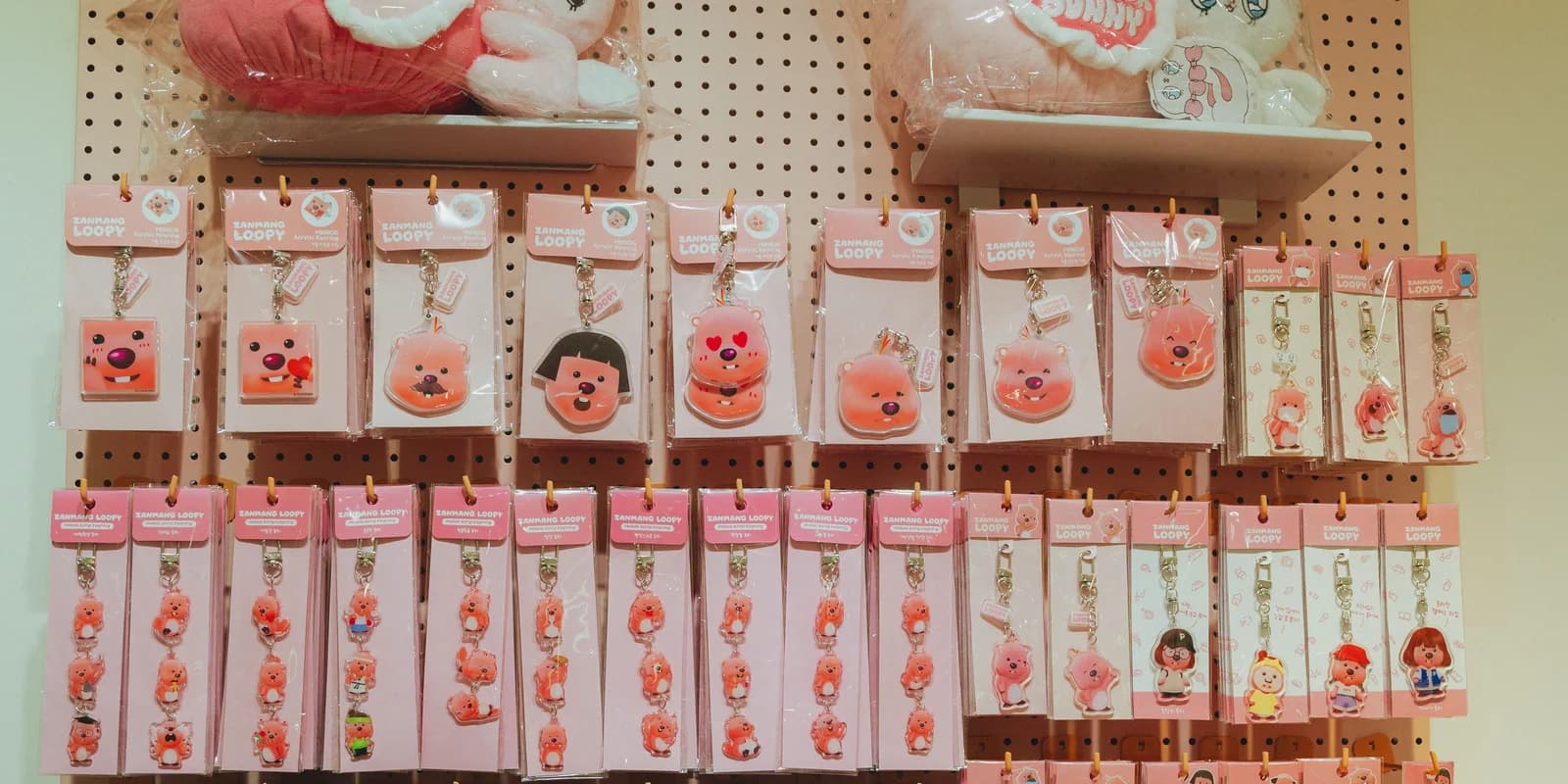
Definitions of 애교, 귀엽다, 아양 and 교태 are from 표준국어대사전 (National Institute of Korean Language); 애굣살 and the "cringe" sense of 오글거리다 are from 우리말샘, NIKL's expert-reviewed open dictionary, and we note where a sense appears in one and not the other. Acoustic findings are from Kim & Dellwo, "Acoustic and Perceptual Differences of Aegyo Speaking Style," Language and Speech (2025). The analysis of intonation, nasality, 혀 짧은 소리 and 오빠, the 2009 variety-show episode, and the "erasure" argument are from Kyuwon Moon's work on aegyo and its media assessments. "Performed winsomeness" and "secondary infantilisation" are Puzar & Hong, The Asia Pacific Journal of Anthropology (2018). Criticism is quoted from the National Human Rights Commission's and Seoul YWCA's media-monitoring reports. On etymology we state only that the compound 愛嬌 is shared with Japanese, where the spelling is documented as an early-modern substitution — no Korean language authority we consulted marks 애교 as a Japanese loanword, and we do not assert that it is. A claim circulating in English that aegyo descends from the role of the 기생 is unsourced and sits poorly against the 1923 attestation, so we omit it. Images: hero — a street-front counter in Seoul; cover — character goods in a Seoul shop; listing card — the finger heart, a studio photograph and not taken in Korea. All three via Pexels.
Keep Reading
More Stories
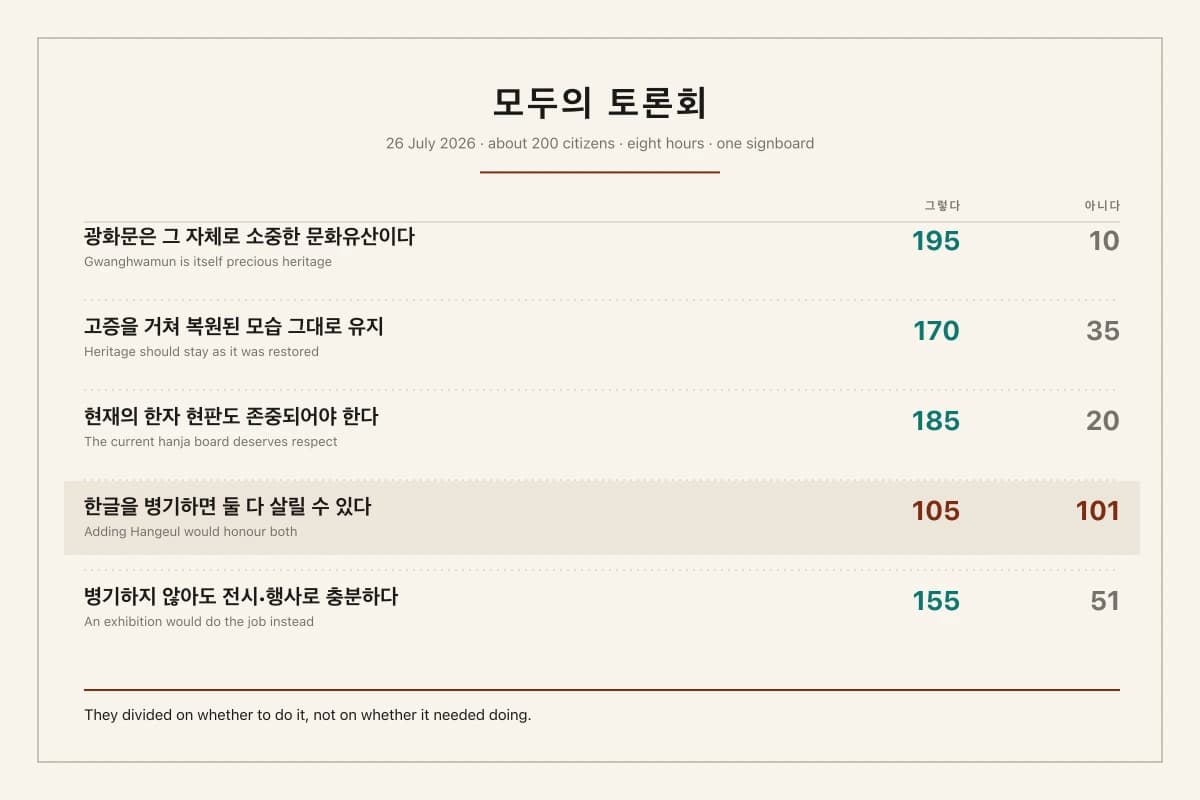
Korea Asked 200 Citizens Whether to Put a Hangeul Sign on Gwanghwamun. They Split 105–101, Then Voted 155–51 That It Is Not Needed.
The government convened its first-ever citizens' deliberation and spent eight hours on a signboard. The panel divided almost exactly in half on whether adding a Hangeul plaque would honour both the heritage and the alphabet — and then, overwhelmingly, said an exhibition would do the job instead. Both answers are coherent, which is the interesting part. The plaque they were arguing about is three years old, and the one before the one before it was in Park Chung-hee's handwriting.
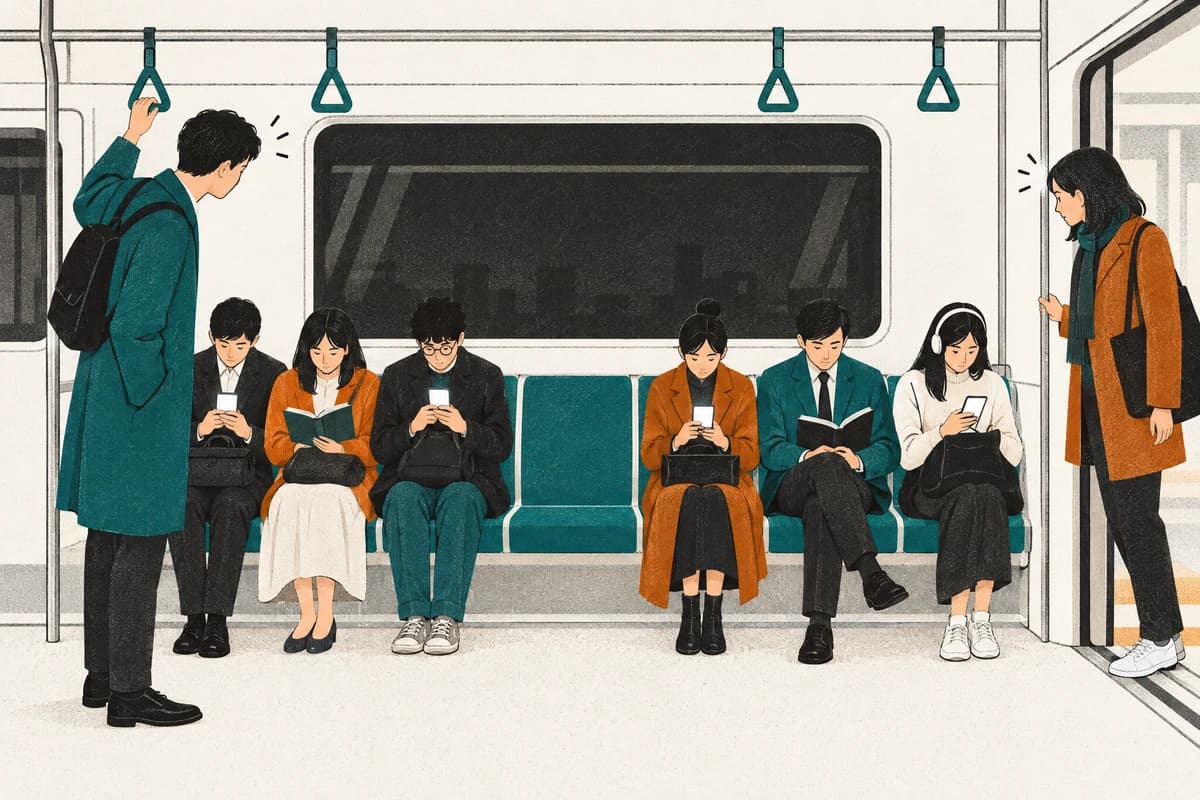
Koreans Have a Word for a Rule Everyone Follows. It Only Ever Gets Used for Rules Not Everyone Follows.
국룰 — gungnul — is Korean internet slang for an unwritten national consensus: the thing everybody does that nobody ever agreed to. It comes from a 2007 shooting game whose players had to invent their own duelling rules because the game had none. And the tell is in which things get called it. Nobody says murder is against 국룰. People say it about which sauce goes with pork belly, and then argue.
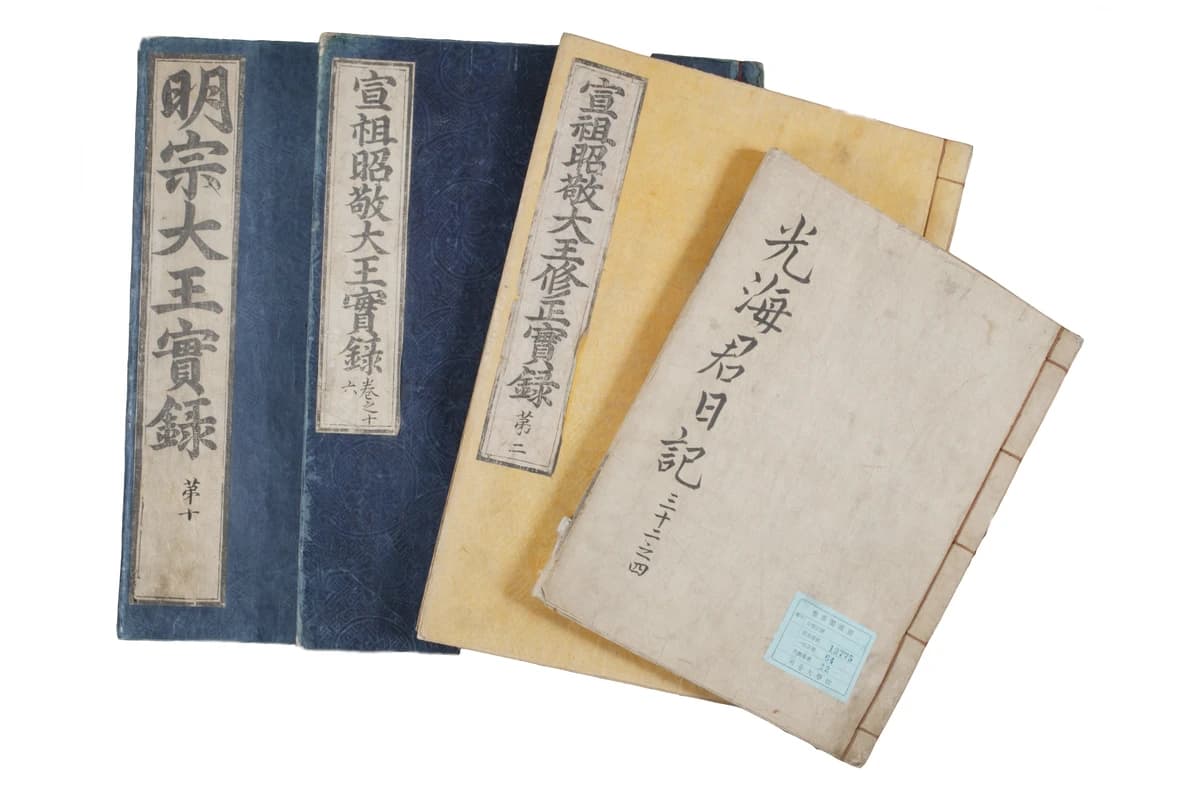
Hangul Day Exists Because a Book Turned Up in 1940. Nobody Can Find the Other Copy.
The date of Korea's alphabet holiday moved four times before a single physical book settled it — and that book arrived missing its first four pages, including King Sejong's own preface, which a calligrapher reconstructed by hand with a typo still in it. A second copy has been in a private house since 2008. The prosecution's own appraisers valued it at over a trillion won. Nobody has seen it since a fire in 2015.
The Weekly Dispatch
Korea, curated. Every week.
The best of K-culture, straight from Seoul. Written by people who actually live here.
Free, no spam, unsubscribe whenever.