Korea's Dog-Stroller Statistic Came From One Company's Christmas Release — Which Also Said the Opposite
The number that travelled the world was a share of two product categories on a single shopping site, over nine months, with no total ever disclosed. Four paragraphs below it, the same release reported that spending on baby strollers rose 22% and spending on pet strollers fell 8%. No English-language outlet has ever printed that.
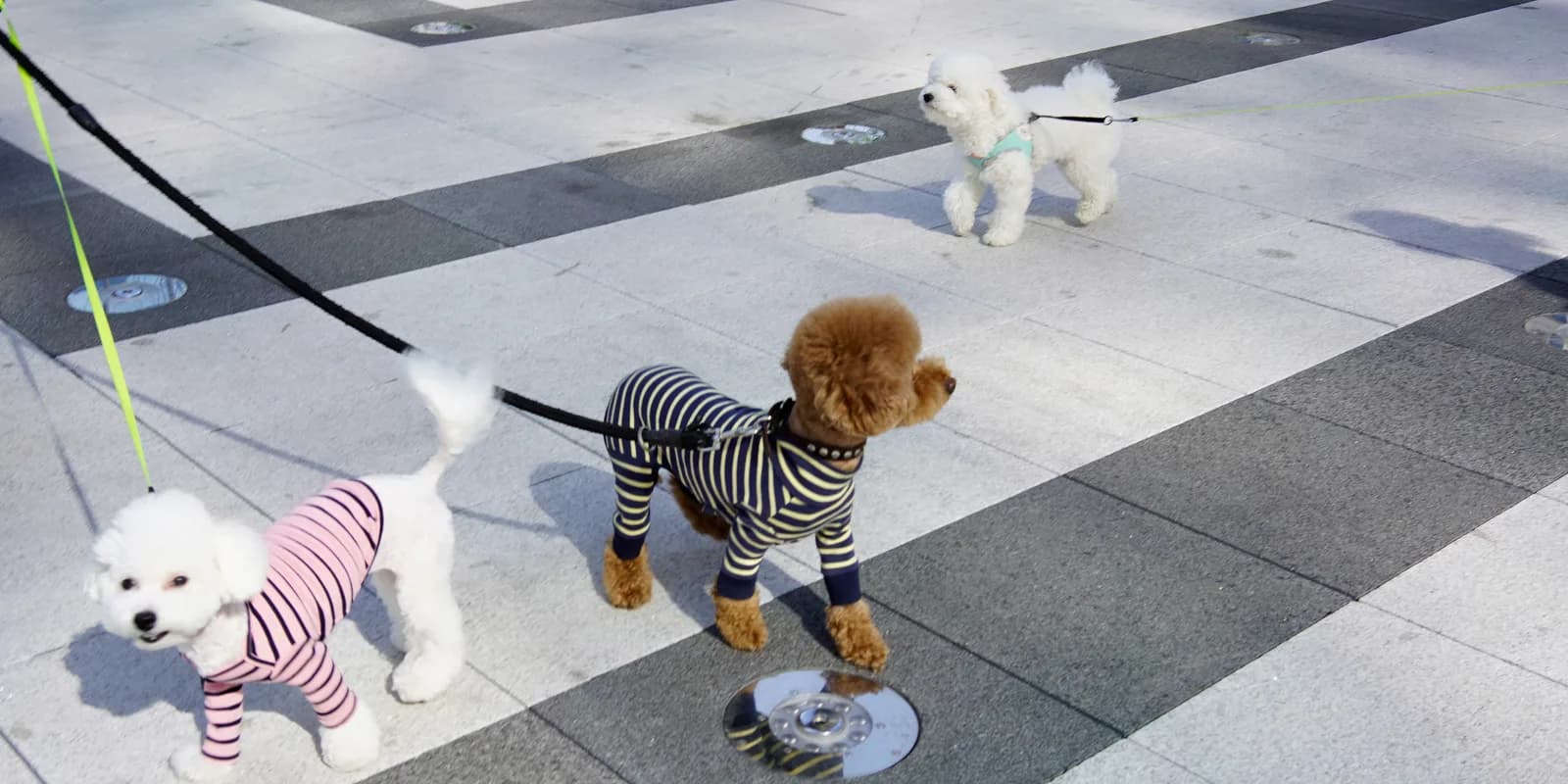
You have probably met this fact. In South Korea, the country with the world's lowest birthrate, more strollers are now sold for dogs than for babies.
It has been in the Wall Street Journal, Fortune, Newsweek, on Japanese television. It is deployed as a punchline, as an omen, and increasingly as evidence — proof of a nation that has swapped children for pets.
Here is where it came from.
On 25 December 2023, G마켓 (Gmarket), a Korean online marketplace, gave Korean reporters a year-end trend note. In it was a comparison between two of its own product categories, covering January to September 2023 — nine months, not a year. The figure was not a count of strollers. It was a share: take the combined unit sales of the two categories, call it 100, and see how it splits.
| Share of the two categories combined | 2021 | 2022 | Jan–Sep 2023 |
|---|---|---|---|
| 반려동물용 유모차 — pet strollers | 33% | 36% | 57% |
| 유아용 유모차 — baby strollers | 67% | 64% | 43% |
That is the statistic. Everything that follows in this article is about the distance between that table and the sentence at the top of this page.
Three Things Gmarket Said That Nobody Carried
It would not tell anyone the actual numbers. From the original Korean wire copy: "G마켓 측은 전체 판매량과 판매액을 따로 밝히지는 않았다" — Gmarket did not separately disclose total sales volume or sales value.
This is not a small omission. A share indexed to 100 has no denominator by construction. Fifty-seven per cent of an undisclosed quantity tells you the ratio between two categories on one website. It cannot tell you whether either category grew, shrank, or collapsed. If baby-stroller sales on Gmarket halved and pet-stroller sales stayed flat, the ratio would flip exactly like this — and the flip would mean the opposite of what everyone thinks it means.
Gmarket said it could not explain its own figure. A company spokesperson, quoted identically in at least two Korean outlets:
"두 카테고리의 비중이 올해 갑자기 뒤집힌 배경은 좀 더 분석할 필요가 있다." The background to why the two categories' shares suddenly flipped this year needs more analysis.
Look at the shape of the series. Three points up across 2021 to 2022, then twenty-one points in a single year. Consumer behaviour does not usually move like that. Something about the platform, the catalogue, or the categories moved. The company that owned the data said as much, on the record, on day one.
And the same release contained spending data pointing the other way. Four paragraphs below the headline figure, in the same nine-month window, on the same platform:
| Per-customer spending, Jan–Sep 2023 vs 2022 | Change |
|---|---|
| Baby and childcare goods overall | +16% |
| Baby strollers | +22% |
| Formula and weaning food | +18% |
| Diapers | +4% |
| Pet goods overall | +2% |
| Pet strollers | −8% |
Spending on baby strollers up 22%. Spending on pet strollers down 8%. Same company, same nine months, same press release.
We have not found this reported in English anywhere. The world took the ratio and left the money sitting next to it.
The Decay, Hop by Hop
The statistic sat in Korean media for nine months. Then, on 8 September 2024, the Wall Street Journal ran it under the headline "Nation With Lowest Birthrate Is Rocked by Soaring Sales of Dog Strollers."
The WSJ's body copy was careful. It said sales "last year outpaced those of baby strollers for the first time, according to Gmarket, one of South Korea's largest online retailers." Named the platform. Correctly said "one of."
What happened next is worth watching closely, because it is the same failure four times:
| What it said | What broke | |
|---|---|---|
| WSJ headline | "Nation With Lowest Birthrate Is Rocked by Soaring Sales of Dog Strollers" | The qualifier is in the body and not in the headline — on the paper's own page |
| Fortune | Body: "citing data from Korean e-commerce platform Gmarket" ✓ · Headline: "…in the country with the world's lowest birth rate" | Body holds, headline nationalises |
| Newsweek | Body: "on Gmarket, a leading South Korean online retailer" ✓ · Headline: "Dog Strollers Outsell Baby Strollers Amid South Korean Birth Rate Crisis" | Same split |
| NextShark | "Gmarket, South Korea's largest online marketplace" | Upgraded "one of the largest" to "the largest." Not true |
| Tortoise Media | "sales of dog prams outpaced those of prams for babies in South Korea" | Gmarket deleted entirely. Also dated it to December, which was the announcement, not the period |
The qualifier survives in the body and dies in the headline. Every outlet that named Gmarket also wrote a headline that didn't, and each subsequent retelling worked from the headline.
A second number decayed the same way in parallel. The WSJ reported that dog-stroller sales had quadrupled since 2019 — attributing it to the head of 펫프렌즈 (Pet Friends), a pet-commerce company, describing that company's sales. One week later, Newser had it as a fourfold rise "across the nation."
And on the "largest online marketplace" claim: by 2024 gross merchandise value, Coupang held roughly 39% of Korean e-commerce and Naver about 28%, while SSG.com and Gmarket together held about 13%. Gmarket's own Korean e-commerce revenue fell 62.8% between the first half of 2021 and the first half of 2025, swinging from operating profit into a substantial loss. A category-share shift on a platform losing customers that fast may describe who is still shopping there rather than what Koreans are buying.
The statistic has never been updated. There is no Gmarket release for 2024 or 2025. Neither 통계청 nor 관세청 publishes a national series comparing the two categories — the comparison cannot be made nationally with Korean data that exists. What the world quotes is a nine-month snapshot from one retailer, now more than two and a half years old.
The Part That Reverses the Story
Korea does have rules about strollers. They are not in a statute — they are in the contract of carriage that Seoul's subway operator publishes, and they say something nobody quoting the dog-stroller statistic seems to know.
서울교통공사's 여객운송약관, the passenger terms for Lines 1 to 8, sets a size limit on what you may bring aboard. Then 제36조 lists what is exempt from it:
"다만, 휠체어, 유아차, 접힌 상태의 접이식자전거는 휴대하고 승차할 수 있으며…"
Wheelchairs, 유아차 — baby strollers — and folded bicycles. A baby stroller is written into the rules as a privileged object.
개모차 is not on that list. It is not anywhere in the document, or in 철도안전법, or in 도시철도법. There is no legal category for a pet stroller in Korea at all. What there is instead is 제35조, which bars animals from the train except where they are
"전용 이동장 등에 넣어 보이지 않게 하고, 불쾌한 냄새가 발생하지 않도록 한 경우"
— in a carrier, and not visible. A conventional pet stroller with an open canopy or a mesh window does not meet that wording. On the face of the operator's own terms, it is a prohibited item, and the operator may refuse boarding.
How this is policed in practice is a separate question, and we have not tested it. But the written rules are the written rules, and they run precisely opposite to the story the world tells about Korea: the baby stroller has protections the dog stroller does not.
The wider legal picture is the same shape. Under Korea's 민법, animals are still 물건 — things. A 2021 government bill to add 제98조의2, declaring "동물은 물건이 아니다," lapsed when the 21st National Assembly expired in May 2024. It was refiled in June 2024 and is still in committee; the Justice Minister said in April 2026 that the government would take it up again. Even the proposed reform keeps applying property rules by default.
Nobody Has Ever Asked
If Koreans were substituting pets for children, you would expect somebody to have measured it.
Nobody has.
We read the questionnaire for 농림축산식품부's 2025 반려동물 양육현황조사 — Korea's first nationally approved statistic on pet ownership, published February 2026. Across every item, there is not one question about children, childbirth, or fertility intention. The reasons it records for not planning to get a pet are lack of time (25.3%), cost (18.2%) and lack of confidence in caring for one (16.3%). Children do not appear.
The same is true of MAFRA's older opinion survey, whose demographic breaks are sex, age, housing type, household size, income and region — and of KB's 2025 pet report, in which the words 출산, 저출산 and 저출생 appear zero times.
Korean academic databases return nothing for the pairing. The one Korean study that comes close finds a negative relationship between the number of minors in a household and money spent on pets — which is not a finding about births, and does not rule out the obvious reverse explanation that children leave neither money nor time for a dog.
Where the question has been asked, elsewhere, the answer points the other way. A Taiwanese study using linked administrative records finds dog ownership rises after a birth. A 2024 Chinese study finds attachment to a companion animal positively predicts fertility intention. Pets and children look like complements, not substitutes.
There is one obvious test nobody has run: Korea's 2020 census carries both a pet-ownership item and a fertility module, and the cross-tabulation has never been published.
And the Owners Are Not Who You Think
The picture that makes the substitution story feel true — the childless young Seoulite with a pampered dog — is not what the data shows. Two government surveys, five years apart, agree.
The 2020 census, a 20% sample of all households with enumerator interviews, by household composition:
| Pet-owning | |
|---|---|
| Three generations or more | 20.1% |
| Two generations | 17.9% |
| One generation | 15.6% |
| One-person households | 9.8% — the lowest of any category |
By age of household head, ownership peaks at 50대 (18.9%) and is lowest among the under-30s and the over-70s. Married people out-own the never-married, 16.5% to 11.9%. Rural and small-town households out-own urban ones, 19.8% to 13.8%.
MAFRA's 2025 approved statistic points the same way: one-person households 23.5%, the lowest; three-or-more-person households 32.2%, the highest; ownership peaking in the 40s and lowest among the over-60s.
On the 2020 census, most pet-owning households were multi-generational, and a majority were headed by someone over 50. The modal Korean pet owner is a married, middle-aged person in a multi-person household, more likely to live outside a big city than in one.
Meanwhile Korea's one-person households — the group the story imagines — are both growing and ageing: 36.1% of all households in 2024, a record, and over 37% of them are headed by someone aged 60 or above. They are the group least likely to own a pet.
A Korean commentator writing in 2024 called the whole picture a 착시, an optical illusion, and offered a mechanism: 랜선 양육, "online-cable rearing" — young people consuming enormous quantities of pet content without owning any pets.
Korea Does Not Know How Many Pets It Has
One more thing worth knowing before anyone builds an argument on Korean pet numbers.
| Source | Pet-owning households |
|---|---|
| 통계청, 2020 census | 15.0% (3.13m) |
| 농림축산식품부 opinion survey, 2022 | 25.4% (6.02m) |
| 농림축산식품부 approved statistic, 2025 | 29.2% |
| 한국농촌경제연구원, end-2022 | 5.52m households |
The census and the MAFRA survey were run in the same country in overlapping periods and differ by almost two to one. Both are correct for what they measure: the census asks only about animals kept for companionship and excludes animals kept for breeding, guarding or hunting, and it uses enumerator interviews; MAFRA's older figure came from an online panel of volunteers who knew the survey was about pets.
MAFRA labels that famous 25.4% itself: "국가승인통계가 아님" — not an approved statistic — and advises caution in using it. It is nonetheless the figure in nearly every dog-stroller article. MAFRA stopped publishing an ownership rate after that wave and replaced the whole exercise with the interview-based approved statistic in 2026.
There is a further wrinkle we could not resolve. MAFRA's household count and the census's household count for the same year disagree by about 2.1 million households. The two surveys do not agree on how many households Korea has, before either of them asks about a dog.
What Actually Happened Next
The statistic froze in September 2023. The underlying numbers did not.
Korean customs data show imports of baby goods — clothing, strollers and the like — rising from $54.1m in 2020 to $99.5m in 2024, with the first ten months of 2025 up another 9.9% by value and 9.4% by weight against the same period the previous year. That is a national series, measured at the border, and it rose straight through the years in which "baby strollers are being outsold" became a global fact.
In May 2026, SSG.com — part of the same corporate group as Gmarket — reported car-seat and stroller sales up 41% year on year for the first four and a half months of 2026.
None of which proves anything about why Koreans have children, and we are not going to pretend it does. Korea's birthrate is a real and serious subject, and we have written about what the numbers are actually doing separately.
But the specific claim that travelled the world was never a fact about Korea. It was a ratio between two shelves in one shop, over nine months, published by a company that declined to say how many of either it sold and said out loud that it could not explain the movement — while reporting, in the same breath, that its customers were spending more on baby strollers and less on pet ones.
Gmarket said the number needed more analysis. That turned out to be the most accurate sentence in the entire story, and the only one nobody repeated.
Korea has a genuine and rapidly growing pet economy — 29.2% of households, a first-ever national statistic to measure it, a dedicated industry act taking effect in 2027, and a civil code still deciding whether a dog is a thing. Those are the interesting stories, and nobody is telling them.
This is a recurring shape rather than a one-off. Korea's couple calendar travels the English-speaking internet as a list that gets the dates wrong and credits the wrong company; the money in a wedding envelope gets quoted as a single national average that two surveys disagree about. In each case the correction is duller than the claim, which is exactly why it doesn't travel.
Photographs, all via 공유마당 (Korea Copyright Commission) and cropped by us: 편의점 강아지, 기증 한지수, 공유마당 (기증저작물, free use); 서울_잠실 4, 한기애, 공유마당, CC BY 4.0; 양재동거리_00015, 이인희, 공유마당, CC BY 4.0. No people appear in any frame and no private data is legible, checked at native resolution. Note that we could not illustrate this article with its actual subject: there is no photograph of a Korean pet stroller under any acceptable open licence — we searched Wikimedia Commons, Openverse, 공유마당 and Pexels. We also declined a technically usable image of an elderly woman pushing an empty baby stroller as a walking aid; using it would have required cropping out her face, which would have made a real person into an illustration of a joke about her country's birthrate.
Verified against Korean-language primary sources: the original 25 December 2023 Korean wire coverage of Gmarket's year-end release, including the 57/43 category split, the per-customer spending figures, and Gmarket's own on-record statements; 서울교통공사 여객운송약관 (as amended 7 March 2026); 민법 as in force 17 March 2026, confirming that 제98조의2 does not exist; 농림축산식품부's 2025 반려동물 양육현황조사 and its published questionnaire; 통계청 2020 인구주택총조사; and 관세청 trade statistics. Gmarket keeps no public archive of its releases, so the release is described from same-day reporting by multiple Korean outlets carrying identical quotations rather than from a corporate document. Deliberately omitted: pet-ownership rates for 2023 and 2024 that circulate widely but are journalists' back-calculations MAFRA never published; a market-size figure whose largest component bundles theme parks and pet travel; and any claim about how the subway rules are enforced in practice, which we did not test.
Keep Reading
More Stories
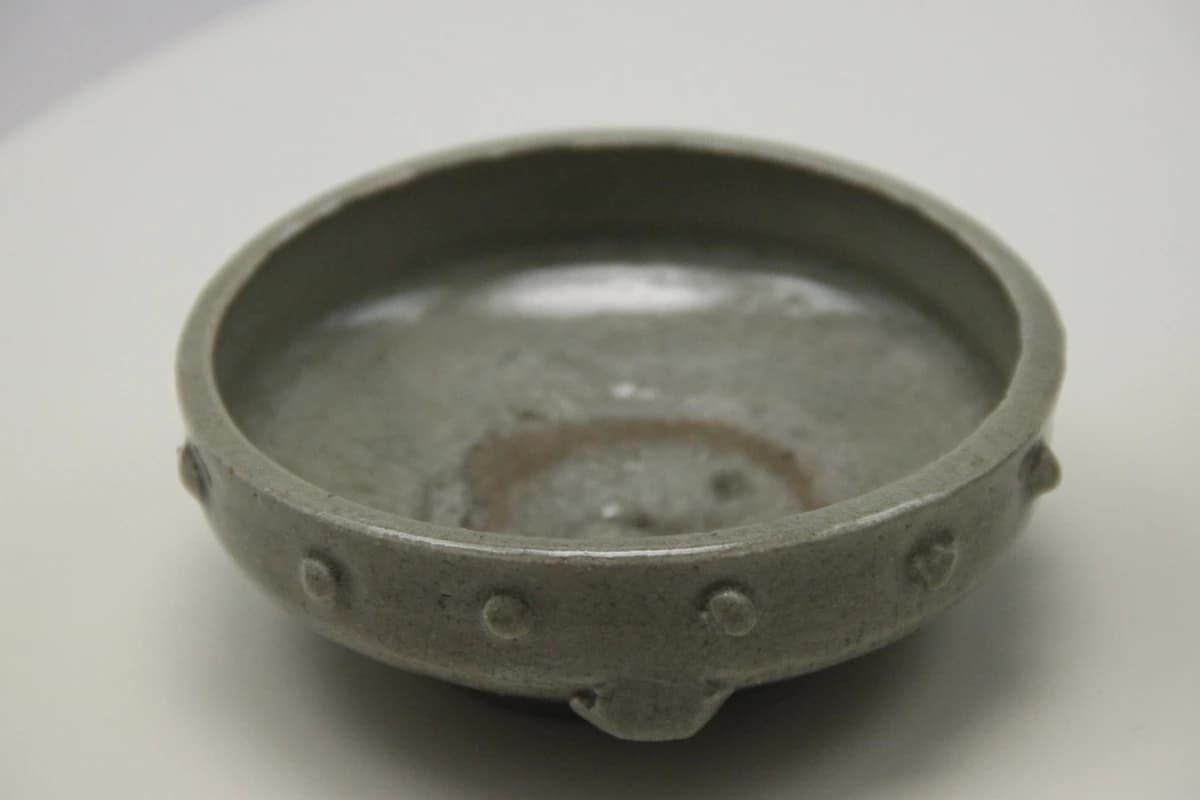
The Fisherman Hid It Under His Floorboards. The Reward He Eventually Got Set Off a Decade of Looting.
Korea marked fifty years of underwater archaeology in Mokpo in September 2026. The official story starts with a net and a report. The documented one starts with six pieces of Chinese porcelain given away as presents, a schoolteacher brother who had to get them all back, and officials who did not want the paperwork. Then the state paid a reward, a diver worked out how much of it went in tax, and for the next ten years people stole the wreck faster than the government could raise it — until the navy's own divers could not find the ship, and the excavation hired the looters.
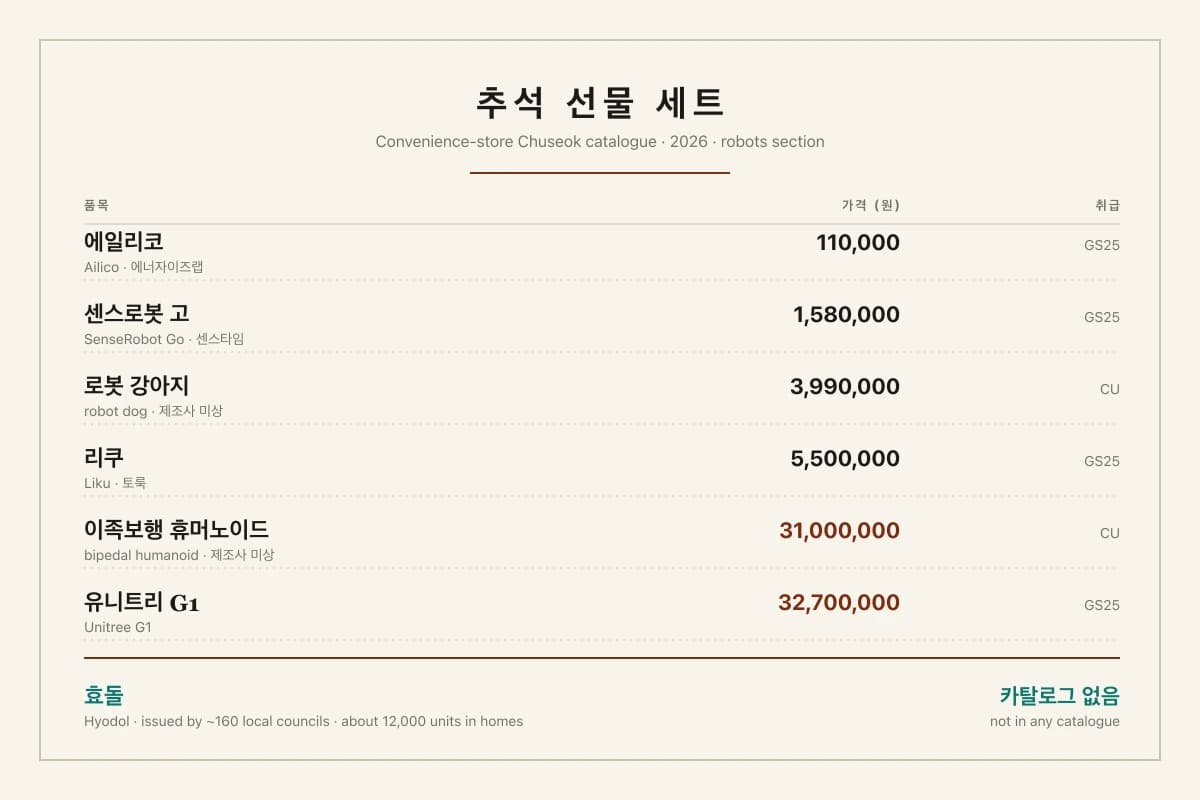
Korea's Convenience Stores Are Selling Humanoid Robots for Chuseok. Neither Chain Expects to Sell One, and Both Have Said So.
CU's holiday catalogue has a bipedal humanoid at ₩31 million, next to the beef and the gold bars. GS25 has an AI companion robot at ₩5.5 million and a keyring that talks back at ₩110,000. We assumed the pitch was companionship for parents you won't be visiting. It isn't — the retailers say plainly these are there to be noticed, not bought. Meanwhile about twelve thousand robots are already in Korean homes, asking elderly residents whether they've taken their medicine, and nobody put those in a catalogue.

The Chuseok Table Rules Your Family Argues About First Appear in Print in 1920 — as an Insult
Red fruit east, white fruit west. Jujube, chestnut, pear, persimmon, in that order. Korean families treat these as ancient Confucian law and fight about them every Chuseok. Scholars who have gone through the ritual classics cannot find them in any of them. What they can find is a 1920 newspaper column using the phrase to mock people who quote rules to seem learned — and a sixteenth-century master who laid his own family's table with six things on it.
The Weekly Dispatch
Korea, curated. Every week.
The best of K-culture, straight from Seoul. Written by people who actually live here.
Free, no spam, unsubscribe whenever.