100 Days, Black Noodles, and a Holiday Lotte Didn't Invent: Korean Couple Culture, Explained
Korean couples count anniversaries in days, not years, and the calendar has a gift day on the 14th of every month. Most of those days are dead, the English list of them is wrong, and the biggest one of all was started by schoolgirls — not by the company that sells the biscuits.
A Korean couple who started dating in April will mark their hundredth day in July. Not their first month, not their half-year — their hundredth day, counted precisely, usually with a cake and a photograph. Then the two-hundredth. Then the three-hundredth. Somewhere in there, on the 14th of most months, the calendar offers another occasion to buy something.
To an outsider this looks like the densest romantic calendar on earth, and English-language listicles have been reprinting it as such for about fifteen years. The reprints get the details wrong, they present a marketing bubble from the early 2000s as a living tradition, and they credit the biggest day of the lot to a company that says, on the record, that it didn't start it.
Here's what Korean couples actually do, what the calendar actually is, and where the standard English account goes wrong.
The Hundredth Day
The core unit of Korean romance is the day, not the year. 100일 (baek-il) is the first real milestone, followed by 200일, 300일, 500일, 1000일, and then 1주년 — the one-year anniversary — running alongside them.
The counting is the first thing worth getting right. The day you started dating is Day 1, so the hundredth day falls on the start date plus 99 days. Start on April 1 and your 100일 is July 9. Every Korean D-day app is built on this rule.
That's inclusive counting, and it's quietly strange, because it is the opposite of what Korean law does. 민법 제157조 — article 157 of the Civil Act — sets the default rule for computing any period in days: 기간의 초일은 산입하지 아니한다, the first day is not counted. Contracts, deadlines and notice periods all drop day one. Couples don't. They count the way Koreans traditionally counted age, and the way a baby's hundred days is counted — inclusively, from one.
Which brings us to the claim you will find in almost every English explainer: that the couples' 100일 descends from 백일 (百日), the celebration of a baby's hundredth day, and beyond that from the founding myth of Dangun.
The baby's 백일 is entirely real. The National Folk Museum's encyclopedia of Korean folklore documents it in detail: 백설기, a plain white steamed rice cake, is served partly as a pun — 백(白), white, on 백(百), hundred — as a wish for a hundred years of life. Red 수수팥떡 wards off misfortune. The rice cake is meant to be shared with a hundred people. The encyclopedia is also clear that the custom is regional rather than uniquely Korean, with counterparts in China, Manchuria and Japan.
The Dangun link is where it falls apart. In the 『삼국유사』 account, Hwanung gives the bear and the tiger mugwort and garlic and tells them to avoid sunlight for 백일 — a hundred days. So the number is there. But the bear becomes human after 삼칠일, twenty-one days. Nobody in the myth completes a hundred days at all. The hundred-day trial is set and then quietly abandoned by the text.
And on the couples' custom specifically: we could not find a single Korean source — encyclopedia, wiki, or newspaper — that connects it to either the baby's 백일 or to Dangun. Nor could we find one dating when Korean couples started marking a hundred days, or who started it. It appears to be genuinely undocumented.
What is documented is simpler and better. The folklore encyclopedia notes that 백일 "carries a meaning beyond the actual number of days since birth — the meaning of many days," and concludes that in Korean folk practice 100 symbolises a large or complete number. That's an honest explanation. The Dangun genealogy is a plausible-sounding story told after the fact.
The 14th of Every Month
Now the calendar. The real list, from the Korean-language sources rather than the English ones:
| Date | Korean | English |
|---|---|---|
| Jan 14 | 다이어리데이 | Diary Day |
| Feb 14 | 밸런타인데이 | Valentine's Day |
| Mar 14 | 화이트데이 | White Day |
| Apr 14 | 블랙데이 | Black Day |
| May 14 | 로즈데이 | Rose Day |
| Jun 14 | 키스데이 | Kiss Day |
| Jul 14 | 실버데이 (링데이) | Silver Day / Ring Day |
| Aug 14 | 그린데이 또는 뮤직데이 | Green Day or Music Day |
| Sep 14 | 포토데이 | Photo Day |
| Oct 14 | 와인데이 | Wine Day |
| Nov 14 | 무비데이 | Movie Day |
| Dec 14 | 허그데이 또는 머니데이 | Hug Day or Money Day |
Twelve dates, fourteen names, because August and December each carry two.
Two corrections to the list that circulates in English. Music Day is August 14, an alternate name for Green Day — not September. And September 14 is Photo Day (포토데이), a day that is missing from nearly every English version, including the ones that otherwise reproduce the table faithfully. If an English list gives you Music Day in September and nothing for Photo Day, it has been copied from another English list rather than from a Korean source.
The larger correction is about whether any of this is real. Namu Wiki's article on 데이 마케팅 — day marketing — is blunt about it: most of these days were 억지 밈, forced or contrived memes, invented to fill out the set. Its verdict is that most of them died, and that what survives is Valentine's Day, White Day, Black Day and Pepero Day. The proliferation is dated to the early 2000s — a Hankook Ilbo piece from October 2000 was already asking readers "did you know the 14th is Wine Day?" — and the whole pattern simply copies Valentine's, which happens to fall on a 14th.
Korean media has been irritated by it for just as long. Headlines from 2006 and 2011 complain about 억지 상술, forced salesmanship, and 우후죽순 — days sprouting like bamboo after rain. Some flopped outright: 에이스데이 on October 31, pushed by Haitai to sell its Ace crackers, vanished completely. 머니데이 backfired when it was widely read as "the day the man spends money on the woman." And the enthusiasm has cooled further — first with the pandemic, then with inflation after 2022.
One more thing the English lists miss. The day Koreans actually associate with confessing feelings is 고백데이, and it falls on September 17 — not on a 14th at all.
So the honest frame isn't "look at this remarkable twelve-month romantic calendar." It's: a marketing bubble inflated in the early 2000s, mostly popped by the 2020s, that English-language content keeps reprinting as though it were folk tradition.
The Two Days That Came From Japan
Valentine's Day in Korea runs on a gendered split: on February 14 women give chocolate to men, and on March 14 — 화이트데이 — men reciprocate with sweets. English writing tends to present this as a striking Korean inversion of the Western norm.
It is not Korean. It is Japanese, and the Korean sources say so without hedging.
Korean Wikipedia's entry on 화이트데이 opens by calling it "a day originating in Japan" and "a commercial anniversary." The detail: in 1977 a Fukuoka confectioner, 石村萬盛堂, began marketing marshmallows to men on March 14 as Marshmallow Day. Japan's 전국 사탕공업 협동조합 — the National Confectionery Industry Association — established White Day in 1978 as an "answer day" to Valentine's, and from 1980 its members pushed it as a national event. Rival Japanese manufacturers still each claim to have invented it, which is itself a sign of how commercial the thing was from the start.
The women-give-first convention was already Japanese too. Valentine's was observed in Japan from the 1930s but only became popular in the 1970s, and there it functioned primarily as an occasion for girls to signal interest in a boy. The gendered direction was settled in Japan before it ever crossed the strait.
It reached Korea in the mid-1980s, via Japan. That dating comes from a 2026 piece in 농민신문 written with the National Folk Museum advising: Japanese confectioners ran a wave of "Valentine's is the day you confess love with chocolate" advertising, and the form set from there.
One Japanese element that did not transfer: 三倍返し, the rule that a White Day return gift should be worth two or three times what was received. There is no Korean equivalent norm, and it shouldn't be imported into descriptions of Korean practice.
It's also worth noting that these days landed on prepared ground rather than empty ground. The same 농민신문 piece notes older Korean occasions with a romantic character — 경칩 in early March, when people who wanted to deepen an attachment would quietly share ginkgo nuts, because male and female ginkgo trees stand facing one another; and 칠석, the seventh night of the seventh lunar month, and the reunion of the separated lovers 견우 and 직녀.
Black Day, Which Korea Did Invent
Then comes April 14 — 블랙데이, and this one is Korea's own.
The premise: everyone who received nothing in February and nothing in March gathers and eats something black, canonically 짜장면, the black-bean noodles of Korean-Chinese restaurants. The name is built directly against White Day.
Korean reference sources are more modest about it than English ones. Namu Wiki's entry is a stub, and its wording is careful — people sometimes eat jjajangmyeon, listed as one of several black foods rather than as the defining ritual.
The best hard evidence that it's real comes from card data. Yonhap reported Samsung Card's analysis of its own customers' spending on Black Day 2022: spending at Chinese restaurants rose 13% against the previous week. The concentration is the interesting part — men in their 20s were up 22%, the largest jump of any group, while women in their 30s moved least at 9%.
That is a real, measurable behavioural signature. It is also a low-double-digit bump concentrated in one demographic, not a nation of singles eating noodles in unison. Both things are true, and the second one rarely survives translation into English.
Black Day is often compared to China's 광군제 on November 11, but the premise differs: that day began as a singles' day whose stated etiquette was that couples should refrain from showing off, and it has since become overwhelmingly a shopping festival.
Pepero Day, and the Correction That Matters Most
November 11 — 빼빼로데이 — is the biggest of them all: the day Koreans exchange 빼빼로, Lotte's thin stick biscuits, because 11/11 looks like four of them standing in a row.
The story everyone tells is that Lotte invented it to sell biscuits. It is the standard cynical explanation, repeated by Koreans online as much as by foreigners.
A 2024 Yonhap fact-check went and checked. What it found:
The first appearance of the term in the press is November 1996, in an article describing a fashion among teenage girls in the Gyeongnam region for calling November 11 "Pepero Day" and exchanging the biscuits, wishing to become slim like them.
Lotte followed. The company began using the name and handing out free Pepero in Gangnam and Changwon the next year, in 1997. The mechanism, as reconstructed by Yonhap: sales reps in Gyeongnam noticed that Pepero sales spiked every November, found it odd, investigated the cause, and reported it up to head office.
And Lotte's own position, given to Yonhap on the record: the company no longer holds records from that far back, but — "회사 차원에서 만들어낸 문화는 아니다." It is not a culture the company created.
Yonhap's summary is the phrase to keep: an anniversary "made by consumers and grown by the confectionery and retail industry."
There is a second correction folded into the same fact-check. Japan has a nearly identical day — Glico's Pocky & Pretz Day, also November 11, chosen because 1999 was Heisei 11, making it 11/11/11. It was first observed in 1999. Korea's version was already spreading among students in the mid-1990s and being marketed by Lotte from 1997. Whatever the biscuits' own history, the holiday ran in Korea first.
Two footnotes worth having. The popular origin story — 1994, Busan, a specific girls' middle school — is not documented. The folklore encyclopedia hedges it as "known to have started," Namu Wiki files the school version as "there is also a theory that," and Lotte says the records are gone. The firm anchors are the 1996 press mention and the 1997 Lotte giveaway; Yonhap's own careful dating is "the early-to-mid 1990s."
And November 11 is also 농업인의 날, Farmers' Day, on which the government promotes 가래떡 데이 — eat a rice cake stick instead — explicitly to push rice consumption against the biscuit. Unlike the failed corporate days, this one had an institution behind it and survived.
Pepero's commercial scale is genuine but every figure is company-issued and should be read that way: Lotte Wellfood projected record annual Pepero revenue of roughly ₩241.5 billion for 2025, with exports around ₩90 billion, up from ₩70.1 billion in 2024 — announced, as Chosun Ilbo noted, in the run-up to Pepero Day, which is itself part of the marketing.
The Words
The vocabulary is where Korean couple culture gets genuinely distinctive, and two words carry most of the weight.
썸 (some) is the stage before dating: mutual interest, nothing declared. It's clipped from the English "something," and its history is better than it looks. The full form 썸씽 was student slang in the late 1970s — but it meant what other people said about a pair: there's something going on there, often with a hint of scandal. The clipped modern 썸, in circulation since around 2011, is first-person. As Namu Wiki puts it, the centre of the word moved from other people to yourself. Grammatically it moved too: 썸씽 was something you had, 썸 is something you ride — 썸타다.
It's distinct from 간 보다 (literally "to taste for salt"), which is calculating and unflattering, and from 어장관리 ("fishery management"), keeping several admirers on the line. The difference is mutuality: a 썸 runs both ways. And nobody ever announces one — as Namu observes, no one has ever said "let's start a 썸." It exists only in retrospect, or in disagreement.
Korean academics have taken it seriously enough to publish on it. There is a peer-reviewed KCI paper by a Sungkyunkwan philosopher analysing the necessary and sufficient conditions for 썸타다, and a philosophy book by a Kyung Hee professor arguing that 썸 is uncertainty about your own will rather than about the other person's feelings.
고백 is the other one — the discrete act of declaring your feelings, the thing that ends the 썸. English writing often treats it as a dedicated romance word. It isn't. The standard dictionary defines 고백 (告白) as stating plainly and without concealment what you have been thinking or hiding — 告, to tell, plus 白, to state plainly. Its second sense is the Catholic sacrament of confession, and its close relative is 자백, confessing a crime.
Korean never coined a special word for asking someone out. It reached for the ordinary word for confession — which is exactly why the act carries the weight it does, and why Korean dating shows are built around it as a climax.
A last piece of evidence, by negative space: Korean had to invent 남사친 and 여사친 — 남자 사람 친구, a male human friend — to say "just a friend." The inserted 사람 is doing all the work, and it only became necessary because 남자친구 and 여자친구 had hardened into "boyfriend" and "girlfriend."
If the vocabulary of relationship status interests you, it runs deeper than romance: Korean encodes age and closeness into the word you use for almost anyone, which we cover in oppa, unnie, hyung and noona. And if you want to watch 썸 and 고백 operate as dramatic structure, that's the entire architecture of Korean dating shows.
Is Any of This Going Away?
Here the data cuts in two directions, and it's worth being careful, because the easy narrative — young Koreans have given up on romance — is not what the official numbers say.
Statistics Korea's 2024 사회조사, released in November 2024, found 52.5% of respondents aged 13 and over agreeing that people should marry — up 2.5 points from 2022, an eight-year high. Acceptance of living together unmarried also rose, to 67.4%. Attitudes to marriage moved up. That sits alongside, rather than against, Korea's rising birthrate.
The counter-signal comes from a different life stage and a weaker source. A private panel survey of 1,000 unmarried people aged 20–49, run by the data firm PMI and reported by Dong-A Ilbo in February 2025, found 71.7% not currently dating, and 29.8% of respondents in their 20s had never dated at all. The most-cited reason was not money but indifference: 37.8% said they felt no interest in or need for a relationship, with a wide gender gap — 51.2% of women against 23.1% of men. It's a commercial panel survey, not an official statistic, and should be read as one.
The vocabulary for opting out is older and well documented. 삼포세대 — the "three-give-up generation," giving up dating, marriage and childbirth — was coined in 2011 by a Kyunghyang Shinmun reporting team, and promptly extended to five, seven, nine and finally N포세대, an open-ended list.
So: fewer people dating, and among those who think about marriage, slightly warmer feelings about it than at any point in eight years. Both at once.
What It Actually Is
Strip away the listicles and Korean couple culture comes down to something fairly legible. Relationships here are marked — in days counted from one, in a photograph at a hundred days, in a discrete declaration that borrows the word for confession, and in gifts on dates that everyone knows in advance.
That last part is the same logic that governs the money in a wedding envelope: a relationship denominated in reciprocal, socially legible spending, where forgetting the date is itself the message. Namu Wiki's explanation of why day marketing worked at all is precisely this — if you forget or skip it, your partner is disappointed, so the consumption becomes semi-compulsory.
The wrong version of this calendar travels much further than the right one, which is a pattern worth noticing. The same thing happened to the statistic about dog strollers — a single retailer's ratio that became, in translation, a fact about a country.
Which is also why most of the days died. The four that survived — Valentine's, White Day, Black Day, Pepero Day — are the ones that attached to something people already wanted to do: give chocolate, reciprocate, commiserate about being single, or hand a cheap biscuit to everyone in the office. Rose Day and Hug Day and Diary Day asked people to perform an obligation with nothing underneath it, and people declined.
The hundredth day, meanwhile, was never sold to anyone. Nobody can say where it came from, no company promotes it, and it is the one that has lasted best.
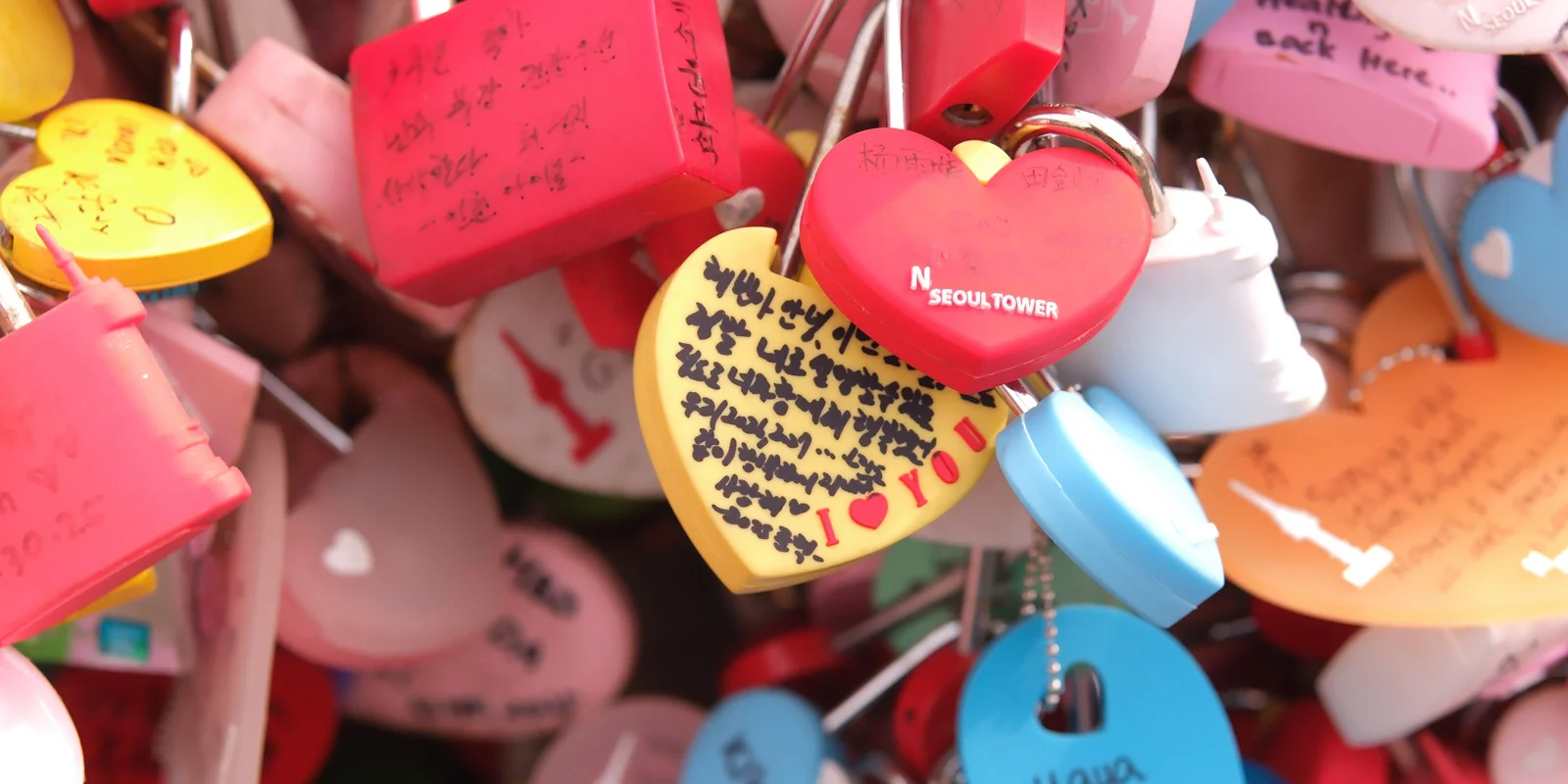
Anniversary counting is drawn from Korean date-calculation conventions and contrasted with 민법 제157조; the Dangun material is quoted from the 『삼국유사』 text via the National Institute of Korean History, and the absence of any sourced link between the couples' 100일 and either 백일 or the Dangun myth is stated as an absence rather than filled in. Pepero Day history follows Yonhap's 2024 fact-check, including Lotte's on-record statement; all Pepero sales figures are company-issued and attributed as such. White Day's origin follows Korean Wikipedia and the Japanese confectionery association's own account, with the Korean arrival date from 농민신문 with the National Folk Museum advising. Black Day spending figures are Samsung Card's analysis of its own customers, reported by Yonhap. The 2024 사회조사 is Statistics Korea; the 71.7% dating figure is a private PMI panel survey and is labelled as such. The 22-day and 50-day anniversaries sometimes listed in English sources are omitted: we could not confirm that either is observed. Images: hero — a couple in matching outerwear on a Seoul street; cover — love locks at N Seoul Tower; listing card — jjajangmyeon, the Black Day dish. All three by their photographers via Pexels.
Keep Reading
More Stories
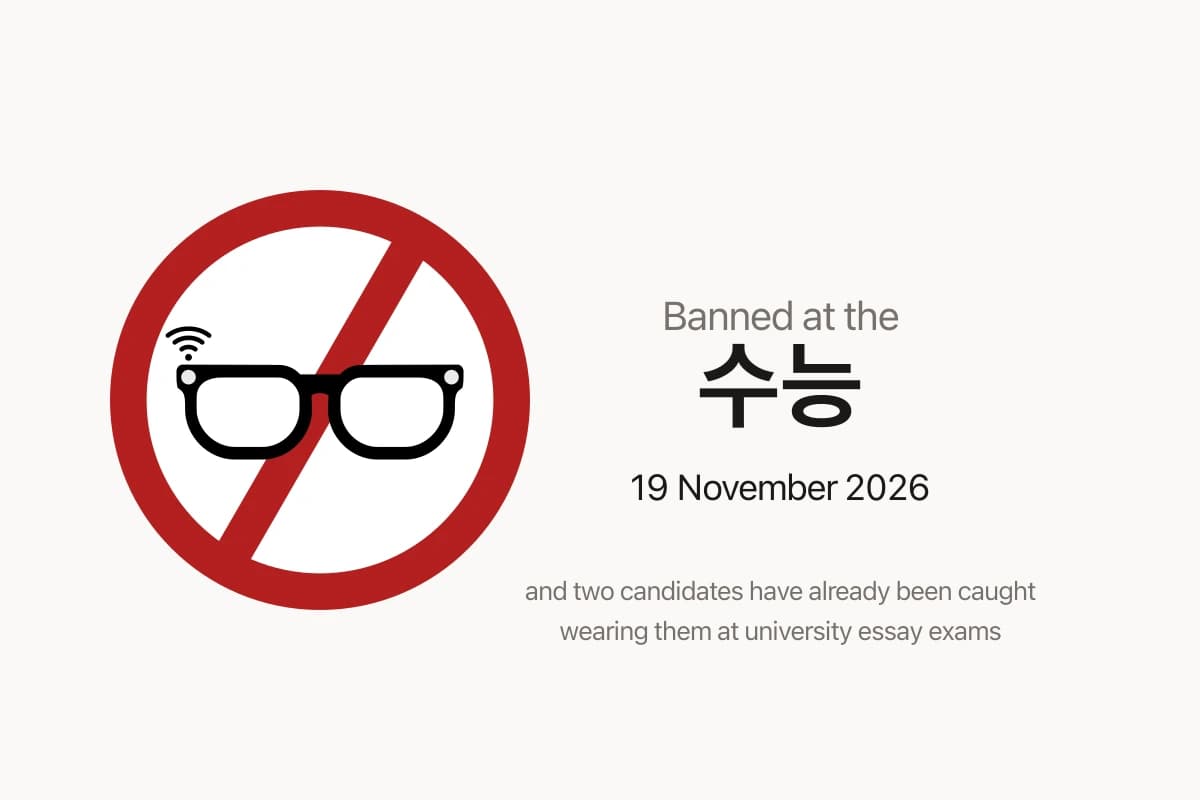
Two Candidates Wore AI Glasses Into Korean University Exams This Month. Five Weeks Later, 550,000 People Sit the 수능
At the University of Seoul on 3 October and at Yonsei a week later, proctors spotted AI smart glasses on candidates sitting essay exams for admission. Both had passed the glasses check in ordinary frames and switched once the exam began. The 수능 on 19 November already bans the devices; the question is whether anyone can see them.
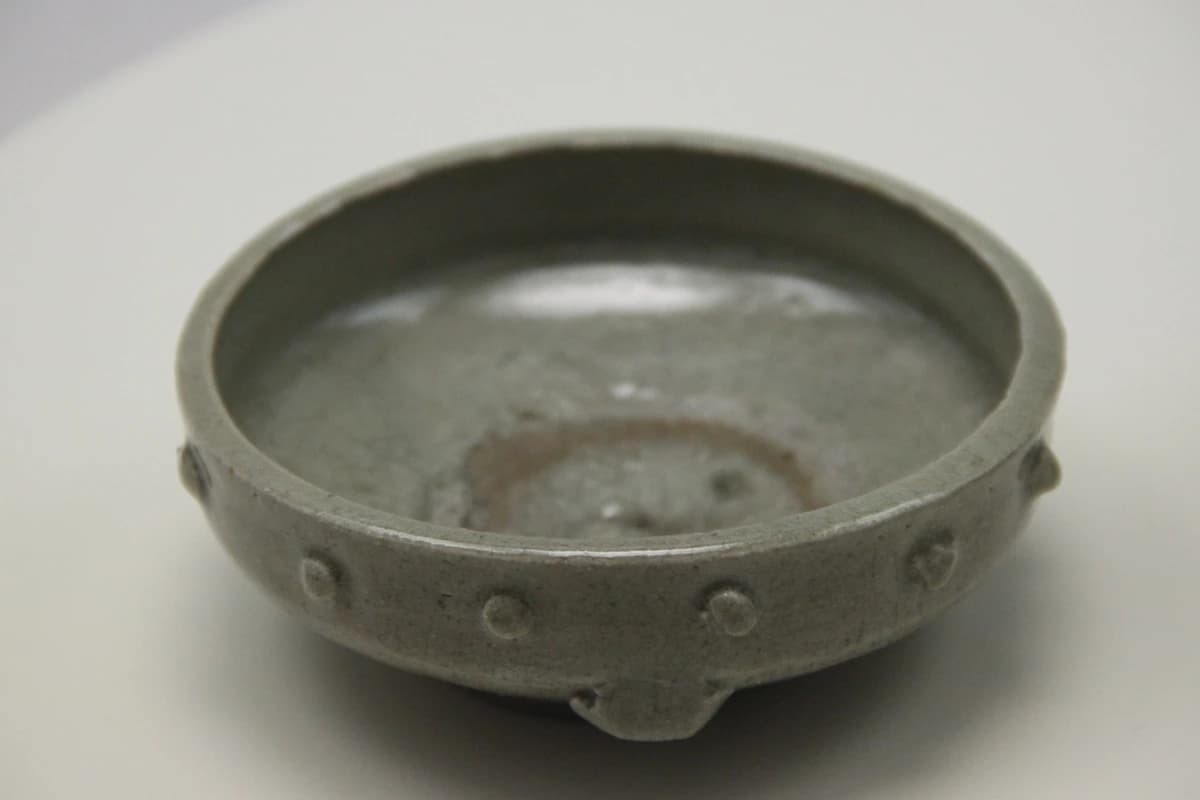
The Fisherman Hid It Under His Floorboards. The Reward He Eventually Got Set Off a Decade of Looting.
Korea marked fifty years of underwater archaeology in Mokpo in September 2026. The official story starts with a net and a report. The documented one starts with six pieces of Chinese porcelain given away as presents, a schoolteacher brother who had to get them all back, and officials who did not want the paperwork. Then the state paid a reward, a diver worked out how much of it went in tax, and for the next ten years people stole the wreck faster than the government could raise it — until the navy's own divers could not find the ship, and the excavation hired the looters.
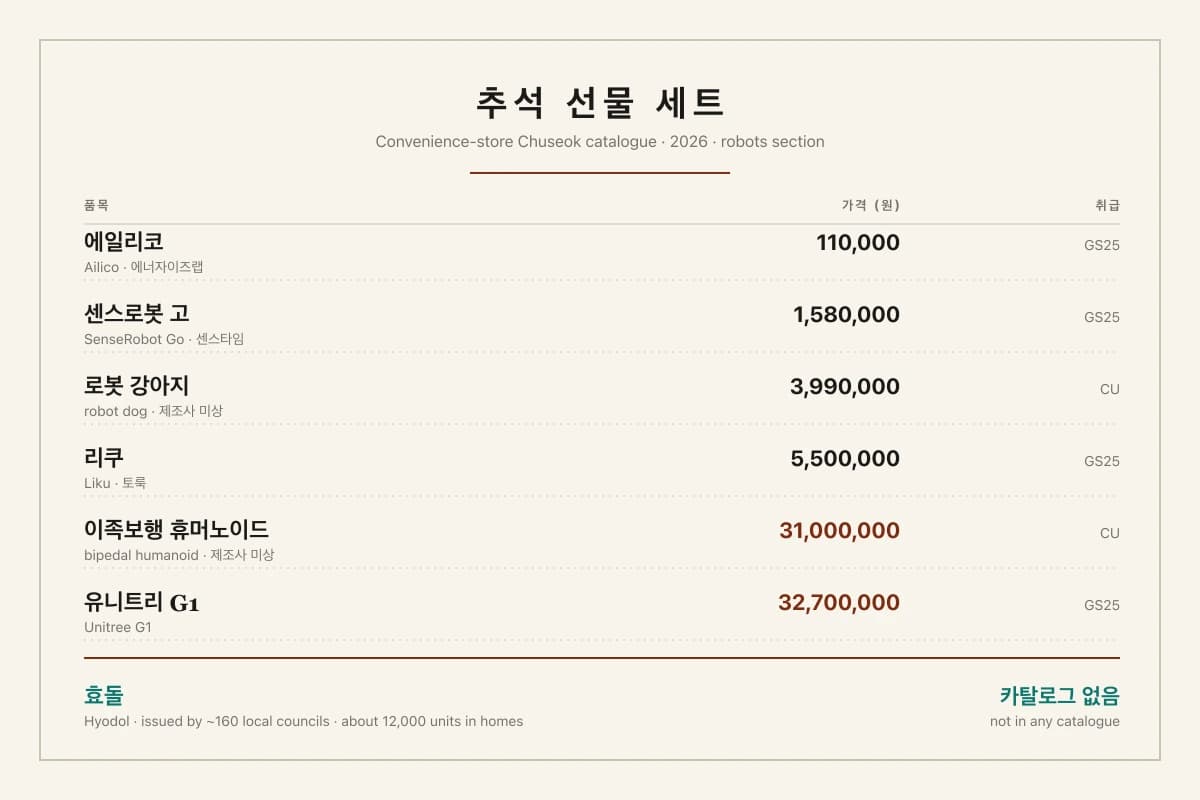
Korea's Convenience Stores Are Selling Humanoid Robots for Chuseok. Neither Chain Expects to Sell One, and Both Have Said So.
CU's holiday catalogue has a bipedal humanoid at ₩31 million, next to the beef and the gold bars. GS25 has an AI companion robot at ₩5.5 million and a keyring that talks back at ₩110,000. We assumed the pitch was companionship for parents you won't be visiting. It isn't — the retailers say plainly these are there to be noticed, not bought. Meanwhile about twelve thousand robots are already in Korean homes, asking elderly residents whether they've taken their medicine, and nobody put those in a catalogue.
The Weekly Dispatch
Korea, curated. Every week.
The best of K-culture, straight from Seoul. Written by people who actually live here.
Free, no spam, unsubscribe whenever.