The Long Memory: Why Korea Can't Stop Talking About 학폭
From The Glory to a webtoon that beats bullies bloody, school violence has become one of Korea's defining cultural fixations — a story about power, records that never quite fade, and reckonings that arrive a decade late. Here's the system behind the headlines, the scandals that changed it, and why 학폭 resonates the way it does.
There is a scene the whole world now recognizes, even if it can't name where it comes from: a woman, years after high school, methodically dismantling the lives of the classmates who once tortured her. That is the engine of The Glory, the Netflix revenge drama that became one of the streamer's most-watched non-English series — and it is only the most famous entry in a genre Korea keeps returning to. School violence, known in its clipped everyday form as 학폭 (hakpok), is not a niche subject in Korea. It is a national preoccupation: a theme for its biggest dramas, a trapdoor beneath its celebrities, and a live argument about fairness, memory, and who deserves a second chance.
To understand why it looms so large, you have to understand three things: what 학폭 actually is, the quiet system that governs it, and why an accusation can arrive a decade after the fact and end a career. This is a guide to all three.
What 학폭 Actually Means
Start with the word. 학폭 is short for 학교폭력 (hakgyo pongnyeok), "school violence" — and it is not merely slang. It is a legal category, defined by the School Violence Prevention and Countermeasures Act (학교폭력예방법) (Korea Ministry of Government Legislation). Crucially, the law reaches far beyond fists. Its definition covers injury and assault, but also confinement, threats, extortion, coercion, defamation and insult, sexual violence, ostracism (따돌림), and cyber-bullying (사이버 따돌림) — harm done through a screen counts the same as harm done in a hallway (Easy Law). In Korean schools, bullying does not have to leave a bruise to be actionable.
It is also common enough to be ordinary. In the Ministry of Education's 2024 nationwide survey, about 2.1% of students reported being victimized — with the most frequent form being verbal violence (around 37%), ahead of physical violence and group ostracism (korea.kr). The rate is highest in elementary school and falls as students get older. These are the numbers under the dramas: not a rare gothic horror, but a routine feature of growing up that the country has decided to take extremely seriously.
The Committee That Judges It
When a case is reported, it does not stay inside the school. Since 2020, it goes to a School Violence Countermeasures Deliberation Committee (학교폭력대책심의위원회) — mercifully shortened to 학폭위 (hakpokwi) — which sits not in the school but at the district education office, and includes outside experts such as lawyers, doctors, and counselors (Namu Wiki). The move outside the school walls was deliberate: it was meant to blunt the pressure that powerful parents could put on a principal or a homeroom teacher.
The committee can impose a ladder of nine measures, escalating with severity: a written apology, a no-contact and no-retaliation order, community service inside or outside school, special education or psychological treatment, suspension, class transfer, school transfer, and — at the top — expulsion, which cannot be applied to elementary and middle schoolers still in compulsory education (Korea Ministry of Government Legislation, Art. 17). It is a genuine adjudication, with hearings, guardians, and often lawyers — a small courtroom for teenagers.
The Record That Follows You
Here is where the stakes turn existential, and where 학폭 stops being a school matter and becomes a life sentence in miniature. Serious measures are recorded in a student's 생활기록부 (saenghwal girokbu) — the cumulative "school life record" that Korean universities read when deciding whom to admit.
After a 2023 overhaul prompted by public outrage (more on that below), the rules tightened sharply. The most serious measures can now be retained for up to four years after graduation, deletion before graduation generally requires the victim's consent, and — the change with the most teeth — a bullying record is now factored into university admissions, becoming mandatory across all universities from the 2026 admissions cycle (korea.kr, Hankookilbo). In a country where the college-entrance exam is treated as destiny, attaching bullying to admissions was a way of saying that cruelty at fifteen can cost you at eighteen.
Why the Past Comes Back
That still leaves the strangest feature of Korean 학폭 culture: the accusations that surface years, even decades, later — the phenomenon the press has called a "hakpok #MeToo."
The mechanics are grimly logical. For offenses committed as minors, criminal statutes of limitations have often long expired, and school records only capture recent, formal measures. So victims who feel they never got justice turn to the one venue still open to them: anonymous online communities, where they name their abusers publicly (SCMP, TIME). Public exposure, not the courts, becomes the court. And when the accused is famous, the exposure is nuclear.
Three Reckonings
The celebrity 학폭 scandal became its own genre around 2021, and three cases show the full range — including the crucial reminder that an accusation is not a verdict.
The case that lit the fuse involved the national-team volleyball stars and twin sisters Lee Jae-yeong and Lee Da-yeong. In February 2021, online posts accused them of severe middle-school bullying; within days, the sisters publicly admitted it and apologized, and were suspended by their club and barred from the national team (Korean Wikipedia, TIME). It opened the floodgates: within weeks, actors, idols, and athletes were being named across the internet.
The case that changed the law was not about a celebrity at all. In 2023, the prosecutor Jung Sun-shin was appointed head of the National Office of Investigation — and the appointment collapsed within a day when it resurfaced that his son had committed verbal-abuse bullying serious enough to warrant a forced school transfer, which the family had fought through appeals all the way to the Supreme Court to delay (Korea Herald). The story of a powerful father using the legal system to shield his son — "아빠 찬스," a "daddy's turn" — became the direct trigger for the 2023 reforms.
And the case that proves the caution is the actor Nam Joo-hyuk. Accused of school bullying in 2022, he denied it; the entertainment outlet Dispatch interviewed 18 former classmates and 2 teachers, who described no such thing; he sued for defamation, and a court ruled in his favor in 2024, with accusers referred over false claims (allkpop, A Koala's Playground). His case is the necessary counterweight: in a system where exposure is the punishment, some of the exposed are innocent. Others remain genuinely unresolved — the actor Jo Byeong-gyu's long dispute was still contested in the courts as of late 2025 (allkpop). The lesson Korea keeps relearning is the hardest one: a formal finding and an online claim are not the same thing.
The Revenge Fantasy
Which brings us back to the dramas — because the culture doesn't just prosecute 학폭, it fantasizes about it. The Glory, written by Kim Eun-sook, turned a bullying victim's decade-long revenge into a global phenomenon; by Netflix's own cumulative viewership counts it ranks among the platform's most-watched non-English series (Wikipedia). Kim has said the seed was a question from her own daughter — whether she'd rather her child beat someone or be beaten.
The appetite goes further still. The webtoon 참교육 ("Get Schooled"), and its 2026 Netflix adaptation Teach You a Lesson, imagine a world where an agent is dispatched to physically discipline bullies whom the system can't touch — a premise so cathartic it drew its own criticism for cheering vigilante violence. The genre's popularity is the tell. A society that produces this many revenge fantasies about school bullies is a society that feels the real system doesn't always deliver.
What It Says About Korea
Put it together and 학폭 is really a story about three Korean anxieties at once. It is about education as destiny — which is why tying bullying to the 생활기록부 and college admissions felt proportionate rather than extreme. It is about fairness, and the fury when the powerful use "daddy's turn" to escape consequences that would crush an ordinary family — the same nerve touched by gapjil and by the "monster parents" who bully teachers on their children's behalf. And it is about memory: a widely shared conviction that a serious moral debt does not expire just because the statute of limitations did.
The 2023 reforms were Korea's attempt to make the official system carry more of that weight, so that justice wouldn't have to be outsourced to anonymous forums and revenge dramas. Whether it worked is still an open question. But the fixation itself is unlikely to fade. As long as the country believes that what happened in a classroom at fifteen says something permanent about who you are, it will keep telling the story — in courtrooms, in committees, and on screens the whole world is watching.
This piece describes a social and legal phenomenon, not any individual's guilt. Where cases are discussed, formal findings are distinguished from unproven allegations: some accused public figures admitted wrongdoing, one (Nam Joo-hyuk) was cleared with accusers referred for false claims, and others remain contested. Viewership figures for The Glory are Netflix's own cumulative, self-reported metric.
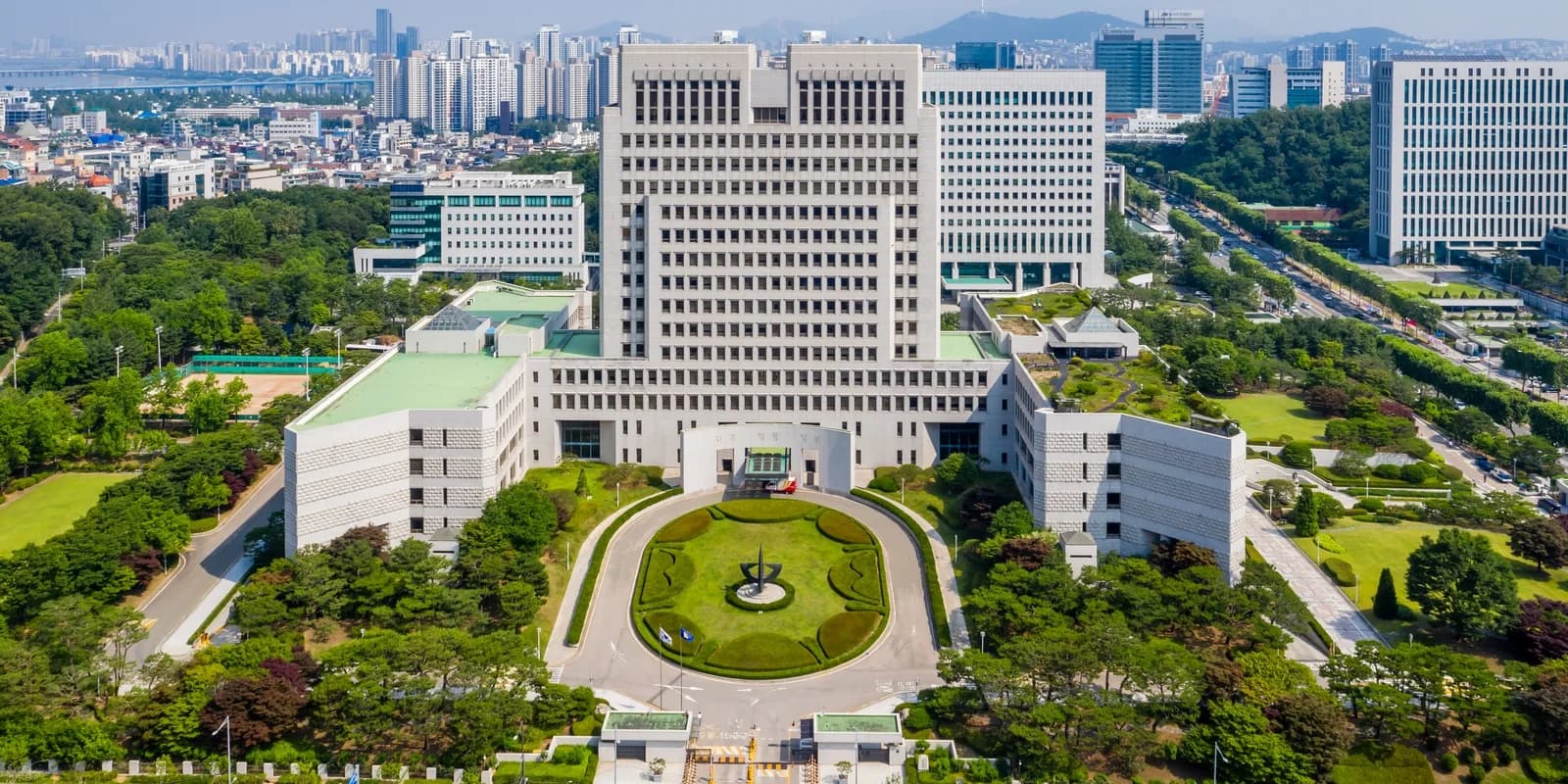
Homepage/hero: Jeonnam High School, Gwangju — photo by Neoalpha, Wikimedia Commons, CC0. Listing card: the historic main hall of Choongang (Jung-ang) High School, Seoul — photo by Lawinc82, Wikimedia Commons, CC BY-SA 3.0. Cover: the Supreme Court of Korea, Seoul — photo by Seoul Institute, Wikimedia Commons, CC BY 4.0. Buildings are shown illustratively; no image depicts any case or person discussed.


.jpg)
Keep Reading
More Stories
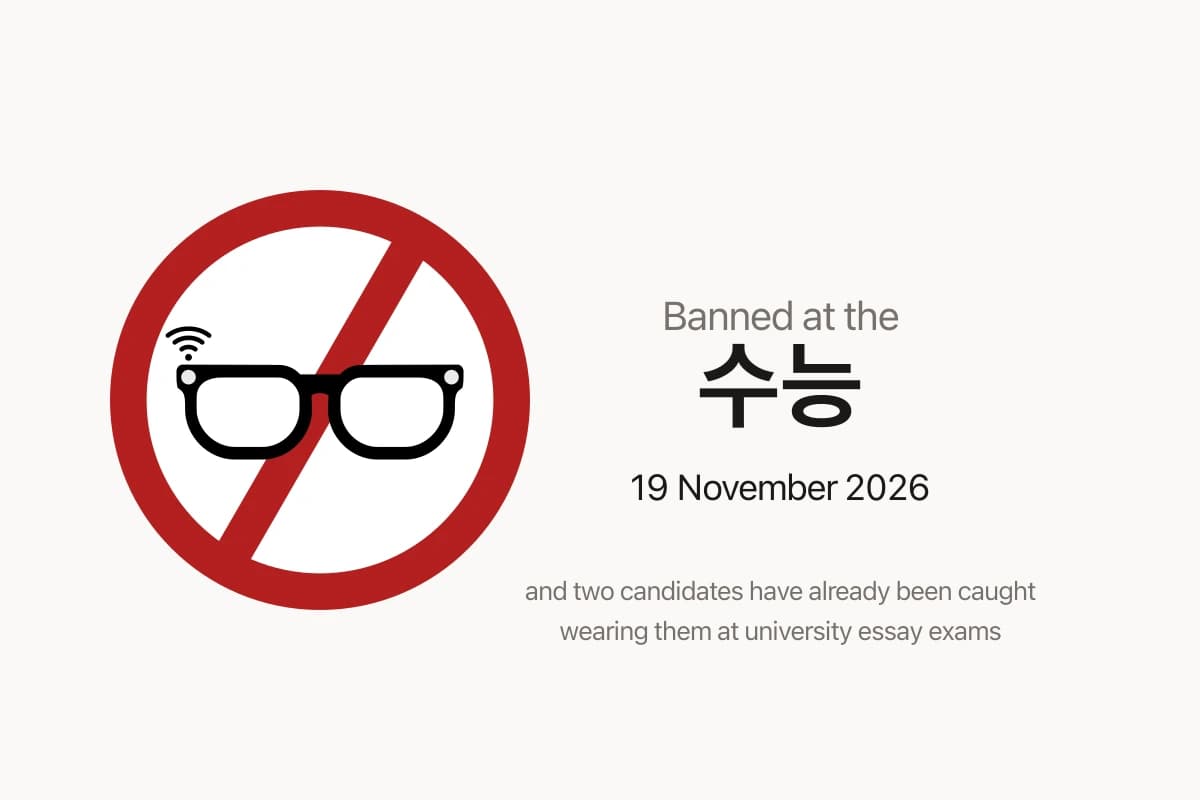
Two Candidates Wore AI Glasses Into Korean University Exams This Month. Five Weeks Later, 550,000 People Sit the 수능
At the University of Seoul on 3 October and at Yonsei a week later, proctors spotted AI smart glasses on candidates sitting essay exams for admission. Both had passed the glasses check in ordinary frames and switched once the exam began. The 수능 on 19 November already bans the devices; the question is whether anyone can see them.

The Fisherman Hid It Under His Floorboards. The Reward He Eventually Got Set Off a Decade of Looting.
Korea marked fifty years of underwater archaeology in Mokpo in September 2026. The official story starts with a net and a report. The documented one starts with six pieces of Chinese porcelain given away as presents, a schoolteacher brother who had to get them all back, and officials who did not want the paperwork. Then the state paid a reward, a diver worked out how much of it went in tax, and for the next ten years people stole the wreck faster than the government could raise it — until the navy's own divers could not find the ship, and the excavation hired the looters.
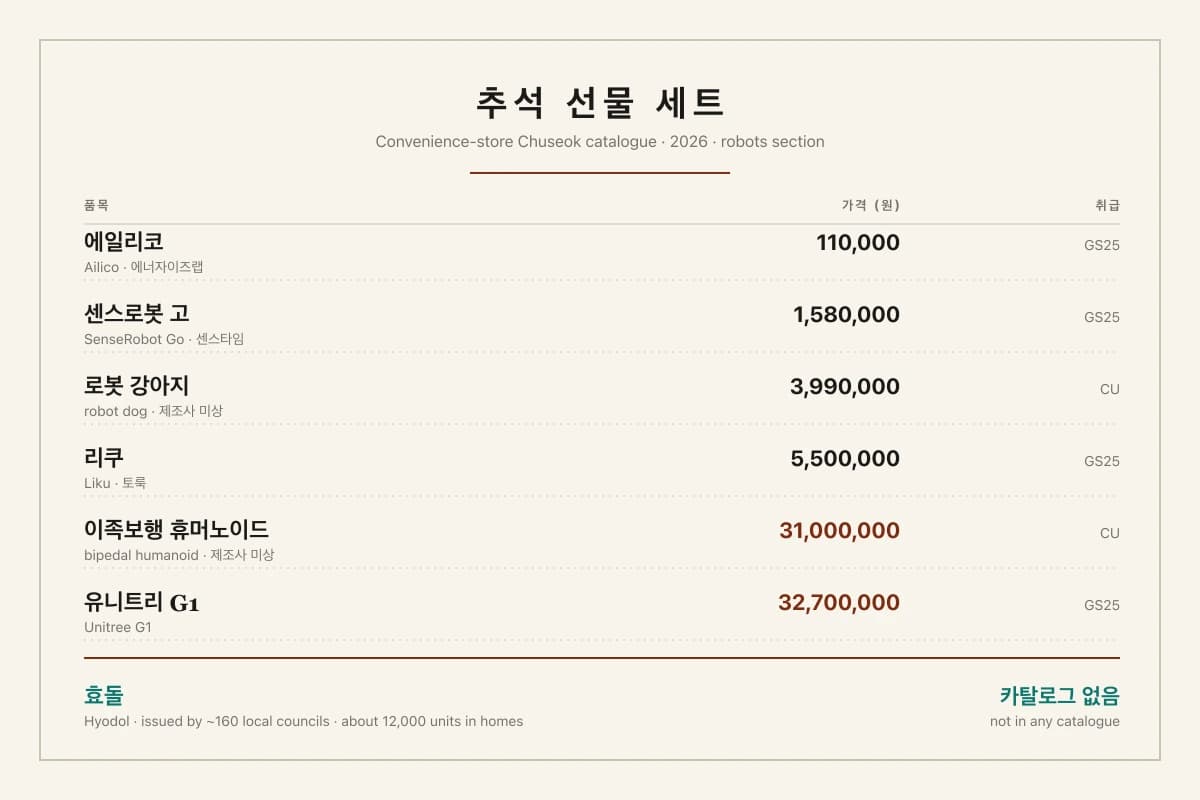
Korea's Convenience Stores Are Selling Humanoid Robots for Chuseok. Neither Chain Expects to Sell One, and Both Have Said So.
CU's holiday catalogue has a bipedal humanoid at ₩31 million, next to the beef and the gold bars. GS25 has an AI companion robot at ₩5.5 million and a keyring that talks back at ₩110,000. We assumed the pitch was companionship for parents you won't be visiting. It isn't — the retailers say plainly these are there to be noticed, not bought. Meanwhile about twelve thousand robots are already in Korean homes, asking elderly residents whether they've taken their medicine, and nobody put those in a catalogue.
The Weekly Dispatch
Korea, curated. Every week.
The best of K-culture, straight from Seoul. Written by people who actually live here.
Free, no spam, unsubscribe whenever.